
 Aziza Ellozy
Originally published on: January 28, 2003
In a study conducted last year entitled “Computer use by Faculty and Students at the American University in Cairo: An ethnographic approach” (September 2002), the authors, Dr. M. Peterson (Anthropology) and Dr. E. Coker (Psychology), concluded that:
“… most [AUC] faculty express an interest in wanting to learn ICT [Information and Communication Technology], but they are concerned about the time it takes. Every non-user mentioned a lack of time to learn the technologies, and a lack of time to perform the implementation. Rather than attending workshops or classes, faculty say they want to learn ICT strategies on their own schedules, at their own pace, and with minimal staff contact time (our emphasis). But when they need the staff, they want them there with the answers or resources immediately.”
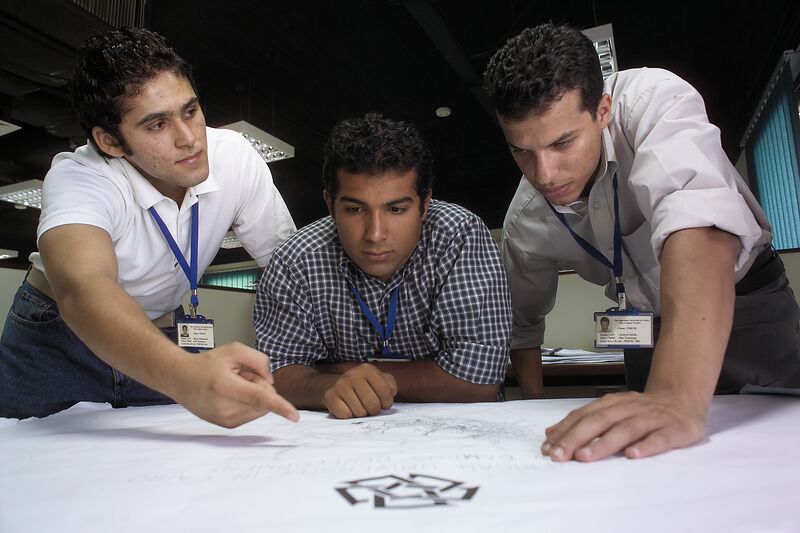
Responding to these concerns, and recognizing that there is an untapped pool of student talent and skill on our campus, the Center for Learning and Teaching (CLT) embarked on a pilot “Student Technology Assistants” (STA) program last fall (2002).
The center has hired graduate students and has trained them (with the collaboration of Academic Computing Services) to assist interested faculty members in preparing instructional materials and/or using WebCT (the course management system adopted by AUC). This has involved assisting faculty members, on a one-on-one basis, “at their own pace and on their own schedules”, on how to use and develop these tools in and out of the classroom. In other words, our STAs have made the equivalent of “house calls” to our faculty.
The services offered are in the following areas:
a) WebCT: one-on-one training and uploading of course material (text, images, PPT slides, grades, etc.)
b) One-on-one training and preparation of PowerPoint presentations
c) Scanning of slides and instructional materials
Twenty-seven faculty members participated in the program and were assisted by seven graduate students. The number of participating faculty members and their corresponding departments are shown in Table I, where:
HUSS = School of Humanities and Social Sciences
BEC = School of Business, Economics and Communication
S & E = School of Sciences and Engineering
| SCHOOL | HUSS | # | BEC | # | S & E | # |
| Department | Philosophy | 1 | Economics | 4 | Biology | 5 |
| Political Science | 1 | Journalism and Mass Comm. | 2 | Chemistry | 1 | |
| SAPE | 3 | Management | 1 | Engineering: Construction | 2 | |
| Engineering: Electronics | 1 | |||||
| Engineering: Mechanical | 1 | |||||
| Mathematics | 1 | |||||
| Physics | 4 | |||||
| # Represents the number of participating Faculty Members | ||||||
Table I.