
 Aziza Ellozy
Originally published on: September 8, 2003
A new academic year has started and the Center for Learning and Teaching would like to welcome you all back. One thing is particularly different this year which you will notice soon enough if you haven’t already: the administration and the Provost’s Task Force on Academic Integrity have embarked on a serious campaign to promote the university’s commitment to the highest standards of academic integrity among all its constituencies: students, faculty members (full-timers and part-timers), teaching and research assistants, technicians and staff members. The provost, Dr. Tim Sullivan, and our new president, Dr. David Arnold, are among the staunchest supporters of this initiative.
The message was made loud and clear this last weekend during Student Orientation and during New Faculty Orientation. It will be reiterated again next week during the TA’s and RA’s Orientation sponsored by the Center for Learning and Teaching. It is therefore only fitting that our first newsletter of the academic year be dedicated to this effort.
The issue of academic integrity is multifaceted and we would encourage anybody involved in the teaching and learning process, who wants to learn more, to visit the new Academic Integrity website that is being launched next week. Right now, we will report on some of the progress made on one aspect of academic integrity, that of plagiarism.
Recognizing that plagiarism is and continues to be a major form of dishonesty in laboratory reports, term papers, and assignments, the Task Force on Academic Integrity recommended last January that AUC acquire the popular plagiarism prevention system, Turnitin.com. We present here the results of our first experience with the software for the Spring 2003 semester.
Forty-six faculty members from all three schools opened accounts and attended the Spring workshops. Of these, thirty-six instructors had their students submit papers, and the results are summarized in Figures 1 and 2.
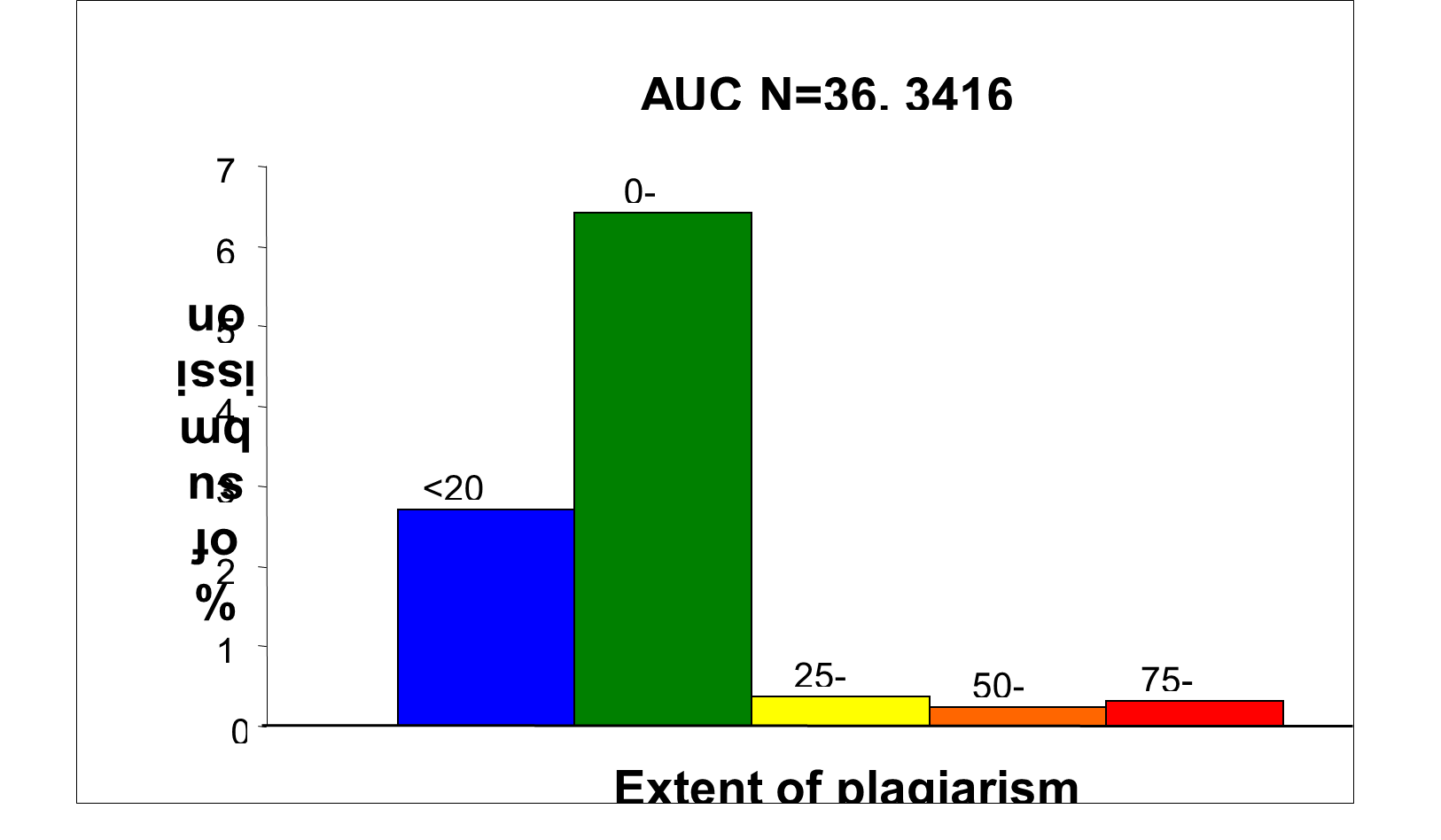
The Writing Program, was responsible for the bulk (85%) of the submissions, followed by the Biology department (5%) (Fig.1). The most encouraging result of all is that 91% of all submissions show that the extent of plagiarism was less than 25%(Fig. 2).
It appears therefore that Turnitin.com has been effective in deterring plagiarism in this first trial. The Writing Program instructors also feel that it can be a powerful learning tool and will be presenting workshops to this effect. Therefore we strongly encourage AUC faculty (including part-timers) from ALL departments to use this software for term papers, assignments or laboratory reports submitted for their courses. This will act as a deterrent and would allow us to
create a database of AUC materials on Turnitin.com, thus permitting teachers to spot recycled papers and lab reports.
Figure 1
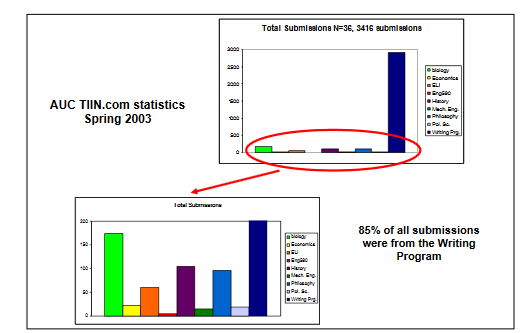
Figure 2