

 Aziza Ellozy
Originally published on: November 7, 2006
Following up on our original emphasis on assessment as an integral part of teaching, this issue (the last of this series) will be devoted to classroom assessment aimed at enhancing the learning and teaching experience through systematic formative assessment. Our previous recommendations included using Classroom Assessment Techniques (CATs) as developed by Angelo and Cross (1993). These CATs are simple tools for collecting data and using it to improve learning. These techniques are not meant to replace traditional forms of (summative) assessment such as exams, quizzes, and term papers, but could supplement them in order to provide instructors with insights on student learning between such tests and allow continuous, effective feedback to students.
The table below has been adapted from Angelo and Cross (1993) and is designed as a practical “how-to” guide to a selection of Classroom Assessment Techniques. The techniques are described and are grouped under broad assessable goals[1] [2] [3]. The specific feedback you will be getting is also included.
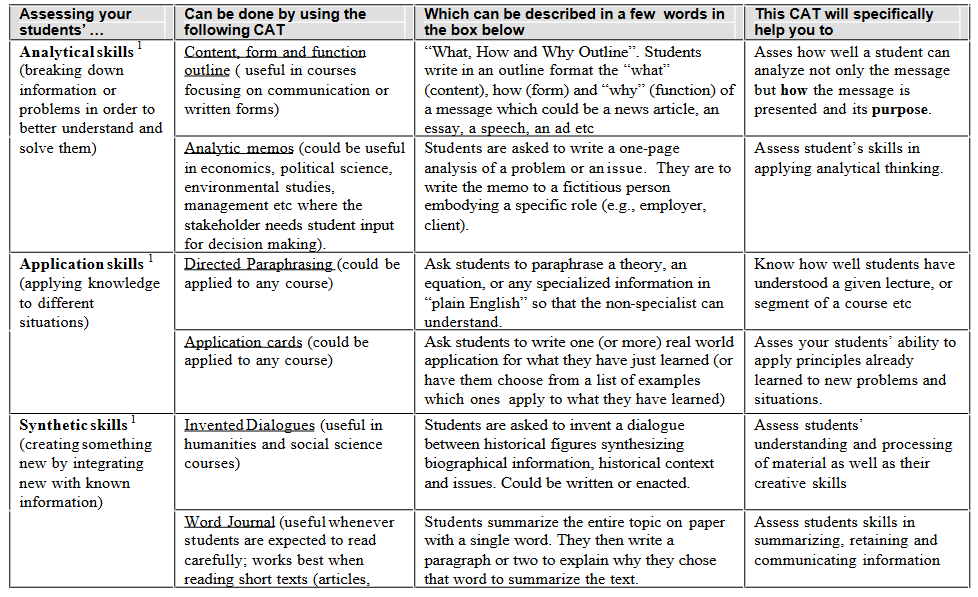
[1] Higher Order Thinking skills
[2] Values
[3] Knowledge
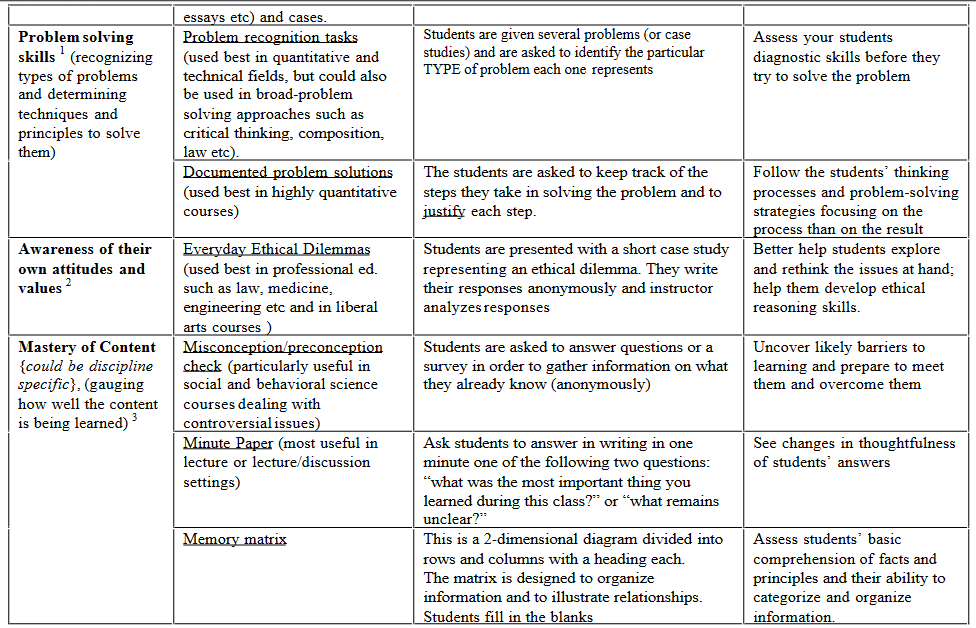
Some of these CATs are easier to administer than others. As a rule, Angelo and Cross recommend “that you ‘get your feet wet’ by trying out one or two of the simplest CATs” at first (like the Minute Paper).
After reviewing the results of your CAT, complete the ‘feedback loop’ by providing students with feedback information and/or suggestions for improvement. Let your students know how that information will affect what you do as the teacher and how it should affect what they do as learners (It is also always useful to allow them to reflect on what they have learned).
The authors emphasize that these techniques are to be used as starting points (ideas to be adapted and improved upon). We hope you will be encouraged to experiment with one of them in your classes and to share your experience with CLT. Should you need more specific support in implementing this type of assessment in your class (or other types[1]) feel free to stop by the Center for Learning and Teaching (FLAC 212A) and talk to us.
Sources
Angelo, T.A., and P. K. Cross. Classroom assessment techniques: a handbook for college teachers. 2nd ed. San Fransisco: Jossey-Bass Publishers, 1993.
[1] Such as “Small Group Instructional Diagnoses” (SGID) or mid-semester surveys.
