
 Aziza Ellozy
Originally published on: April 17, 2007
“Better thinkers…”, this is what an AUC education promises to deliver. Yet “thinking” is an outcome we do not often assess. We assess content learning, we assess student satisfaction and we spend a lot of effort evaluating teaching. We collect data on students’ perceptions of how much “critical thinking” has been emphasized by their instructor, but ask them what critical thinking is and their answers would be mostly speculative. We do not however assess the intellectual development of our students as the final outcome of an AUC education.
I do NOT propose to embark on such an endeavor. I am not aware that this is an outcome that we can assess at the university level or for that matter at the curricular level, but I would like to start a conversation about how to help our students develop their higher order thinking skills.
Numerous studies (Perry, 1970; King and Kitchener, 1994; Baxter Magolda, 1992) have shown that the intellectual development of adults occurs in “stages” and that there are different levels of thinking. These studies have also shown that the development of complex cognitive skills does not occur automatically as we grow older and that it needs a supportive environment in which students are explicitly taught to become “better thinkers”. A successful education therefore would be one which helps students attain higher levels of thinking.
So how applicable are these studies to our setting at AUC and how can we teach to elicit higher order thinking?
Most students entering AUC come from a culture where working hard and memorizing information is rewarded with success. They rely on “authority” (their instructors, the textbooks, notes etc) to guide them through the process. They know the rules of the game and what to expect if they stick to them. They then come to a place where (if we do it properly) they are suddenly confronted with rules that have shifted considerably and where the emphasis on thinking “critically” and “independently” may catch them unprepared. This may frustrate them and we in turn are frustrated that they are not what we wish them to be. This is especially true with freshmen and sophomore students. I hear continuously instructors complaining that students are not what they “used” to be, that they cannot think properly, that they are spoon fed and that it is very difficult to change these habits. And yet our job is to turn this around.
I contend that if we are to truly help them develop intellectually we need to make use of what research tells us about how to address this question. We may also be surprised to find out that, like their counterparts in the US, they may not be cognitively prepared to tackle what we sometimes expect of them.
For the purpose of this discourse, I propose to use the results of Harvard psychologist William Perry’s groundbreaking study of the 1960’s. Although this study is dated and involves only Harvard male students, it is one of the most influential models of intellectual development and is the paradigm for subsequent equally influential models such as King and Kitchener’s “Reflective Judgment Model”, and Belenky’s Women’s Ways of Knowing. The most important outcome of these studies is the realization that students go through intellectual developmental stages and that most of those entering college are NOT ready for higher order thinking.
Perry’s study found that students exhibit nine developmental stages divided into four broad categories, from the less complex to the more complex stages. These categories and the characteristics of students within them can be summarized in the following table:
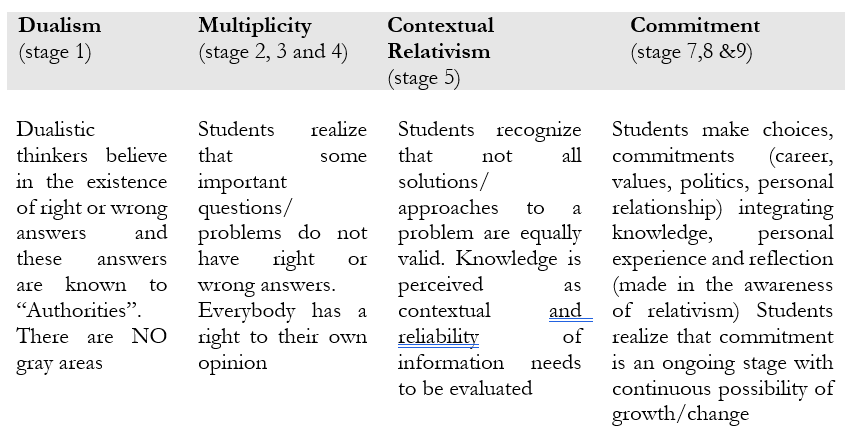
In the next New Chalk Talk issues, we will be examining these stages with an eye on recognizing them in our students and on exploring how to help them move on to higher thinking levels.
Sources:
Perry, W.G. (1970). Forms of intellectual and ethical development in the college years: A scheme. Austin, TX: Holt, Rhinehart and Winston.
King, P.M., & Kitchener, K.S. (1994). Developing reflective judgment. .San Fransisco: Jossey-Bass.
Marcia B. Baxter Magolda (1992). Knowing and Reasoning in College: Gender-Related Patterns in Students’ Intellectual Development. San Francisco: Jossey Bass Publishers.
Mary F. Belenky, Blythe Clinchy, Nancy Goldberger, and Jill Tarule (1986). Women’s Ways of Knowing. New York: Basic Books.
