

 Aziza Ellozy
Originally published on: March 3, 2009
The first time I heard a lecture on Web 2.0 was in April 2006 at a “WEBIST” conference in Portugal. At the time, I don’t think I quite understood what this new phase of the web meant, except that it was a collection of software that allowed for collaborative publishing. The speaker kept talking about the “user” having taken over the web and creating online content.
Today, the term “2.0” has caught on like fire: Learning 2.0, Teaching 2.0, Business 2.0, Enterprise 2.0; PR 2.0, Media 2.0, Classroom 2.0, Campus 2.0, etc. While I will not go into the etymology of the term, suffice it to say that the phrase “Web 2.0” describes a significant transition in the use of the Internet as it went from a global “information” space to a more “social”, “collaborative” and “participatory” space. Users have taken over and are “creating” content, collaborating, communicating, and forming professional and social networks like never before.
What has made this possible? It is the emergence of a number of Web-based services and applications which are collectively called “social software” (blogs, wikis, social bookmarking sites, RSS feeds, social network sites like Facebook, media sites like YouTube and Flickr, etc.) whose main characteristic is that they are user-friendly and that many of them are free.
“In Web 2.0, the software recedes into the background…it has to be very easy to use because the slightest hurdle may cause the user to abandon it for something else” (Vassileva, 199-214)
This means that online content can be created by anybody without the specialized skills once needed to create a webpage. Users have been transformed into consumers and producers of web content.
As individuals, many of us have kept up with and are adopting some of these new technologies for our personal use. Even AUC has embraced “podcasting” and “YouTube” as the software of choice to disseminate AUC activities to the outside world, and has made available applications like “Google Docs” and “Google Sites” (a wiki application) for the AUC community to use.
The questions I am posing here focus on the implications of this technological shift for education: Has education kept up with this shift? Should it? In what way does it help facilitate learning? What are the challenges and what are the opportunities?
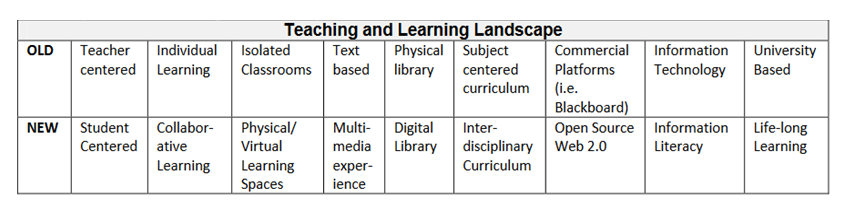
If you have followed the discourse taking place in educational circles or in our CLT workshops/meetings, it is clear that a significant shift has occurred in the teaching and learning landscape. The following table briefly summarizes this change[1].
Our role as teachers, however, still remains the same: we are there to guide the learning experience and to facilitate the students’ relationship with the discipline. And yet, we need to rethink how we do it, because what has worked in the past may no longer be helpful.
Most university courses and curricula are designed based on learning theories of the 1900-1960’s and are essentially content-driven, lecture-based, and teacher-centered. Our biggest challenge today is designing courses that are truly student-centered, that take into account the challenges of a globalized, information-centered world and that address the needs of a generation of students that has grown up in a digital environment (the so-called Net Gen students).
So does Web 2.0 fit in all of this? The answer is “yes” with the usual caveat: like any other technology, the use of Web 2.0 technologies should be driven by specific learning goals.
My friend and colleague, Pandeli Glavanis, often quotes Emile Durkheim (“The social power of ideas stems from their development through the interaction of many minds”) to emphasize that learning is a social process. If nothing else, Web 2.0 applications allow for this “interaction of many minds”. They are the tools of choice to help learners connect, communicate, and collaborate.
A growing number of college instructors are discovering that these tools provide innovative teaching and learning opportunities that mirror current approaches to learning. The challenge is figuring out how to incorporate these paradigm-altering technologies to achieve the outcomes we seek. If this is something that interests you, sign up for CLT’s Web 2.0 crash course and join the discourse.
Sources
Alexander, Bryan. “Web 2.0: A New Wave of Innovation for Teaching and Learning?” EDUCAUSE Review 41(2006): 32-44.
McNaught, Carmel. “Are learning repositories likely to become mainstream in education?” WEBIST-2006. Portugal, Setubal. April 2006.
Vassileva, Julita. “Toward Social Learning Environments.” IEEE Transactions on Learning Technologies 1(2008): 199-214.
[1] Adapted from Carmel McNaught’s presentation at the WEBIST-2006 conference by A. Ellozy
