

 Aziza Ellozy
Originally published on: May 25, 2004
“Assessment is an ongoing process aimed at understanding and improving student learning. It involves ….. systematically gathering, analyzing and interpreting evidence to determine how well performance matches [those] expectations and standards; and using the resulting information to document, explain and improve performance.” T.A. Angelo, November, 1995, AAHE Bulletin v. 48, n. 3, p. 7.
This past week, students have been busy filling their evaluation forms, and once again they may or may not have insightful comments on how your course(s) and/or teaching can be improved. In an ideal situation, you would recognize patterns in their feedback, and should they recur over different semesters, you would act upon them to improve and fine-tune your teaching.
I would like to suggest however that there is an additional and potentially powerful way of reviewing the effectiveness of your courses, which can complement your students’ perspectives. I am referring to the embedded data in WebCT, which can be retrieved and analyzed at leisure when the end-of-semester pressure is off. Although it will not assess your teaching, it can help you review your course and possibly introduce improvements. I am talking specifically about a) the statistics of the quiz tool, b) the data on the page tracking tool, c) the discussion board entries, and d) the student tracking tool.
- Frequent quizzes and short answer essays can be very useful for formative assessment purposes, and the statistics given by the WebCT quiz tool can help identify questions that may be problematic, as with questions #5 and #8 below, or questions that may be too easy such as #1.
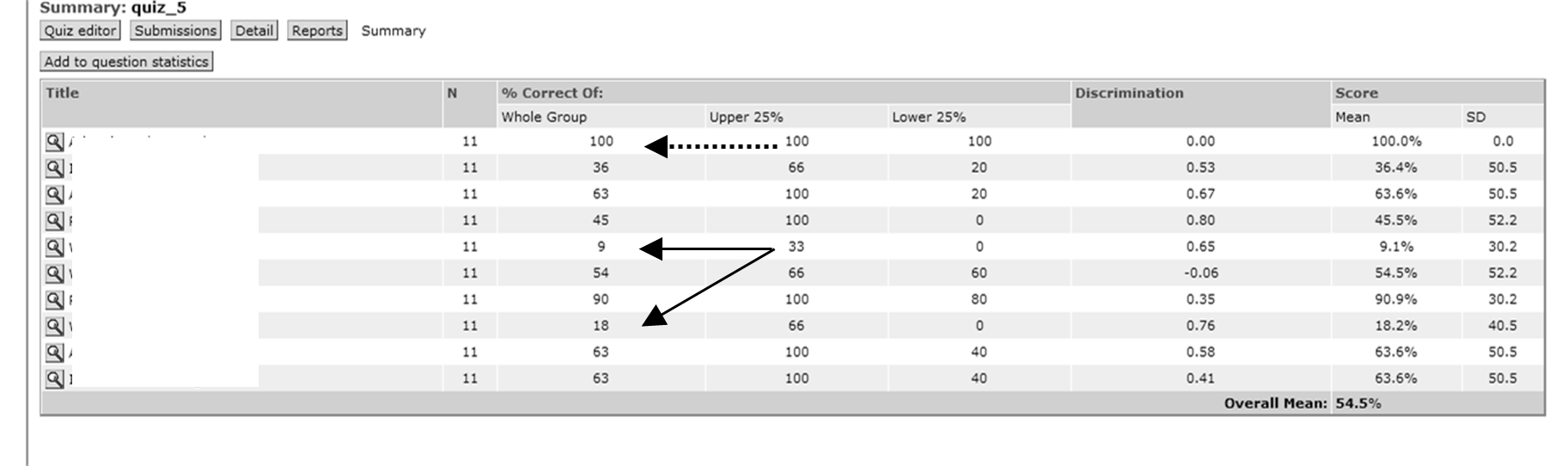
The anonymous data shown in this issue were generated at AUC this semester
b) The page tracking tool allows you to see how the content pages of your course have been visited. Which pages were visited more than others? Which pages were not visited? Is there a need to restructure some of the content modules?
c) Proponents of online discussion see it as a very valuable tool: it can help students’ writing skills, can motivate shy students into participating and, at its best, can promote students’ critical thinking skills. However getting students to engage in meaningful discussions can be difficult and requires practice. Keeping a record of discussion forum postings is useful in understanding what works best, or simply in preserving good discussion items for the future.
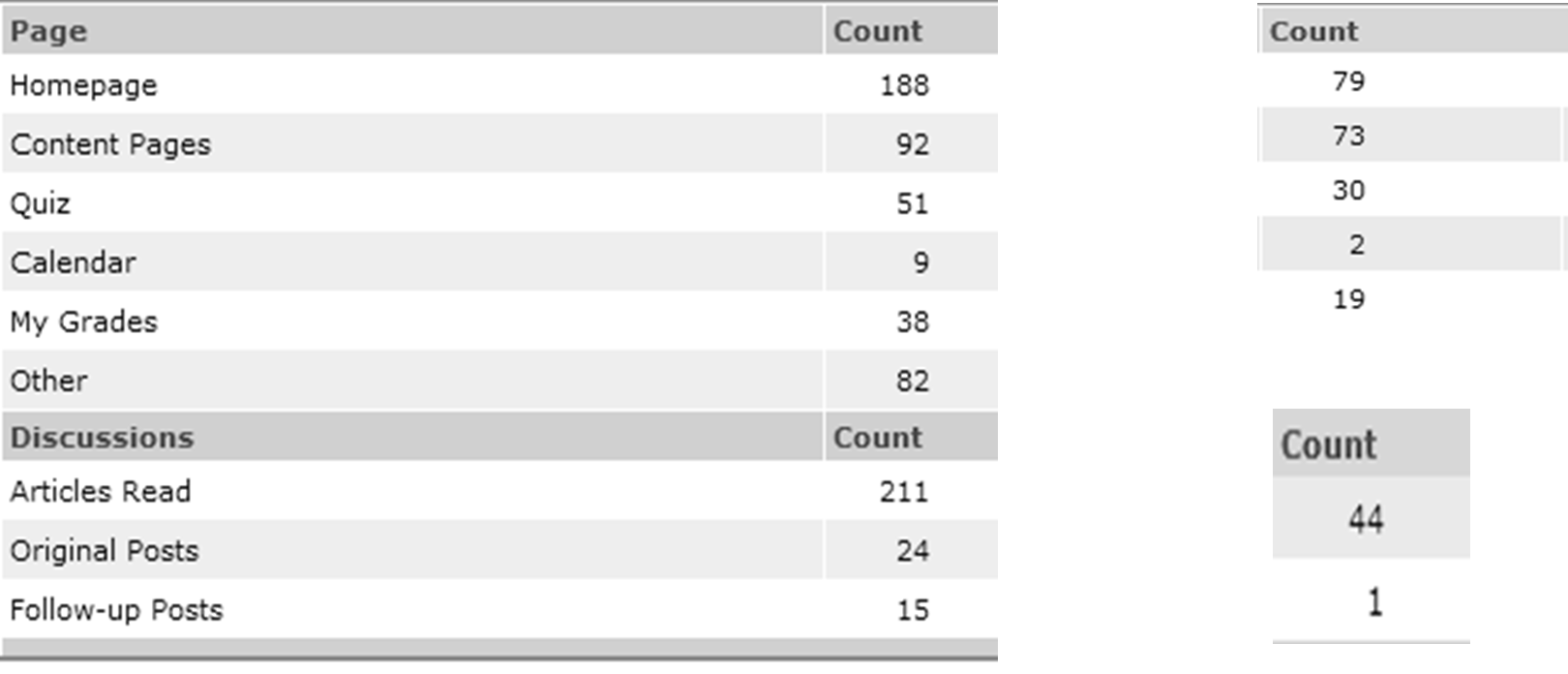
d) The student tracking tool is used primarily to trace individual student use of the various pages or sites. An example is shown below where the online activities of two students (from the same class) are compared with the grades they received during the semester. In this example, there is a correlation between the students’ online activity and their grades, and although these numbers alone may not be sufficient to yield insights on student learning, together with other input they may indicate what you are doing best to enhance learning.
| Student 1 | Student 2 |
|---|
| Some of their grades |

In conclusion, you will soon be asked by Academic Computing Services (ACS) if you would like to archive your WebCT course(s). ACS will archive your course content automatically but if you would like to archive the statistics of any of the tools you have used this semester, you need to request it specifically from them.
Have a great summer and see you again in September ember!
