

 Aziza Ellozy
Originally published on: February 21, 2006
On February 8th, 2006, the Task Force on Academic Integrity and the Center for Learning and Teaching had the pleasure of hosting Dr. Don McCabe, an expert on academic integrity issues in higher education and the founding president of the Center for Academic Integrity, “a consortium of over 400 colleges and universities based at Duke University who are joined in a united effort to promote academic integrity among college and university students”.
Dr. Don McCabe, Professor of Organization Management at Rutgers University, has done extensive research on college cheating over the last fifteen years, surveying over 100,000 students at more than 140 colleges and universities in the U.S. and Canada.
AUC’s association with Dr. McCabe started in 2002 when the Provost’s Task Force on Academic Integrity sought his help in conducting a campus-wide web survey to assess the state of academic integrity at AUC. The survey was conducted in the spring of 2003, and 656 AUC students as well as 60 AUC faculty members participated.
During his visit, Dr. McCabe gave a two-hour session on “New Developments on the Academic Integrity Front,” where he shared the results of his latest research and discussed the 2003 AUC results. This was followed by another two-hour session where representatives from the Provost’s Task Force on Academic Integrity, the Academic Integrity Committee, and the Center for Learning and Teaching presented and discussed AUC’s “Policies, Practices and Lessons Learned”.
AUC 2003 Survey
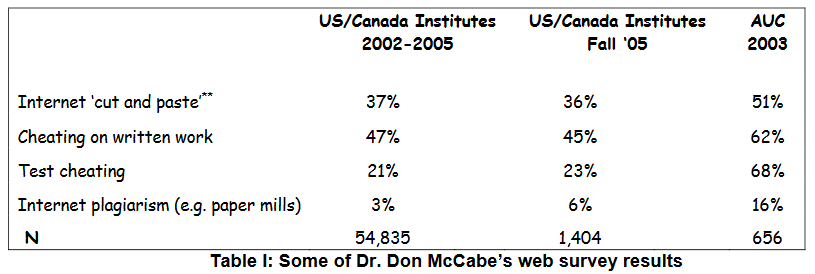
In this newsletter, we highlight some of the results presented. In Table I, results of the AUC 2003 web survey of undergraduates are compared to those of their counterparts in the US/Canada.
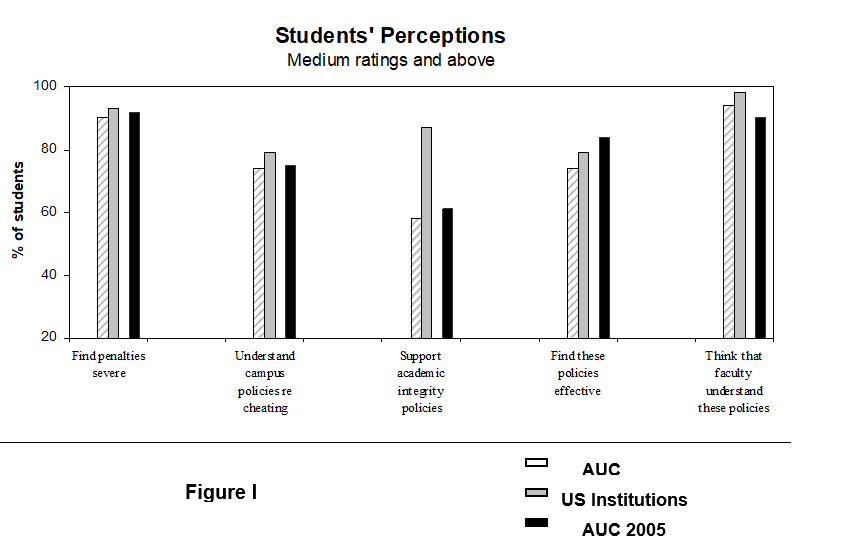
This comparison extends in the figure above, where perceptions of AUC students vis-à-vis certain issues are highlighted.
AUC’s 2005 Survey
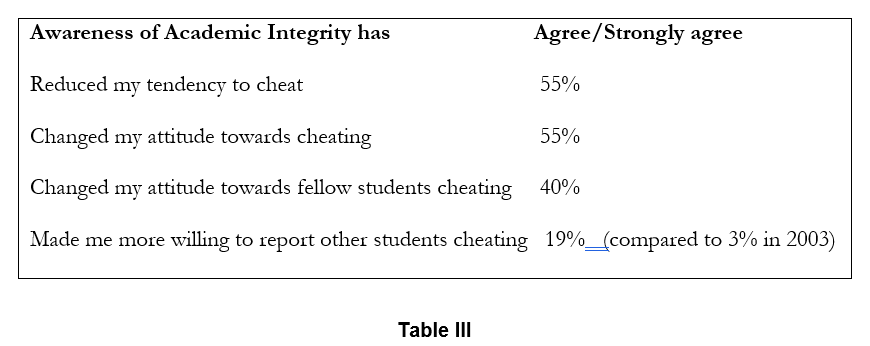
To assess the effect of AUC’s two-year academic integrity campaign, an in-house survey was conducted last summer where 322 undergraduate students participated. The results are shown in Figure I and Tables II and III.
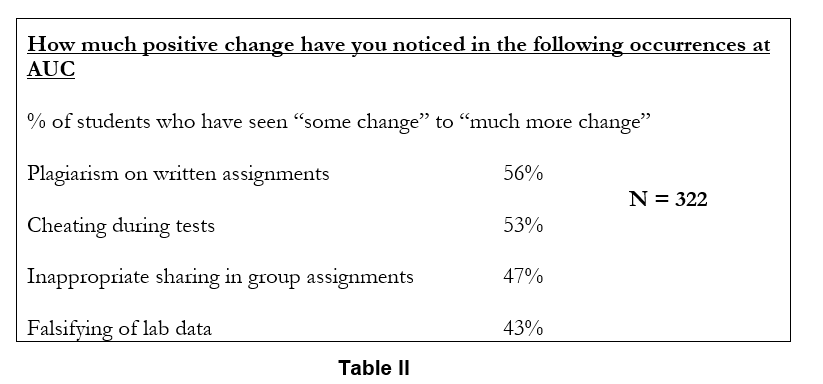
An interesting result of AUC’s effort these last two years is that, although AUC students do not support academic integrity policies as much as their counterparts in the US/Canada do, there is a definite change in their perception of the effectiveness of these policies (Figure I). This is mirrored by the more detailed results in Table II, where more than half the students surveyed reported seeing a change towards less plagiarism and less cheating. It appears, however, that, as faculty, we need to be more explicit as to what constitutes legitimate group work and what does not. Results also indicate that we need to be more diligent in addressing falsification of lab data.
Answers to questions that addressed students’ perception of their own individual change with regard to academic integrity are shown in Table III. They are encouraging. A majority of students agree/strongly agree that the academic integrity campaign has reduced their tendency to cheat.
Among the most significant remarks made by Dr. McCabe is that AUC is perhaps the only university he knows of that requires its faculty/students/administrators to sign the Code of Ethics (75% of our faculty have so far signed the Code of Ethics). Along those same lines, Dr. Abou Zeid received a request concerning the Code of Ethics. It reads:
“…I was referred to your Code of Academic Ethics and related documents, including the Student and Faculty Agreements. We were impressed with the content of the document and interested in adopting your material…” Academic Advisor for Northeastern State College, College of Business and Technology, Oklahoma, USA.
Dr. McCabe concluded his presentation with a discussion of strategies to consider as we continue our efforts to promote and sustain academic integrity. He specifically emphasized education vs. punishment and the need to give students a primary role, a sense of ownership: “Let them build a ‘new’ tradition”. Finally, there was a consensus among all those present that striving for academic integrity is an ongoing process, a journey and not a destination.
