
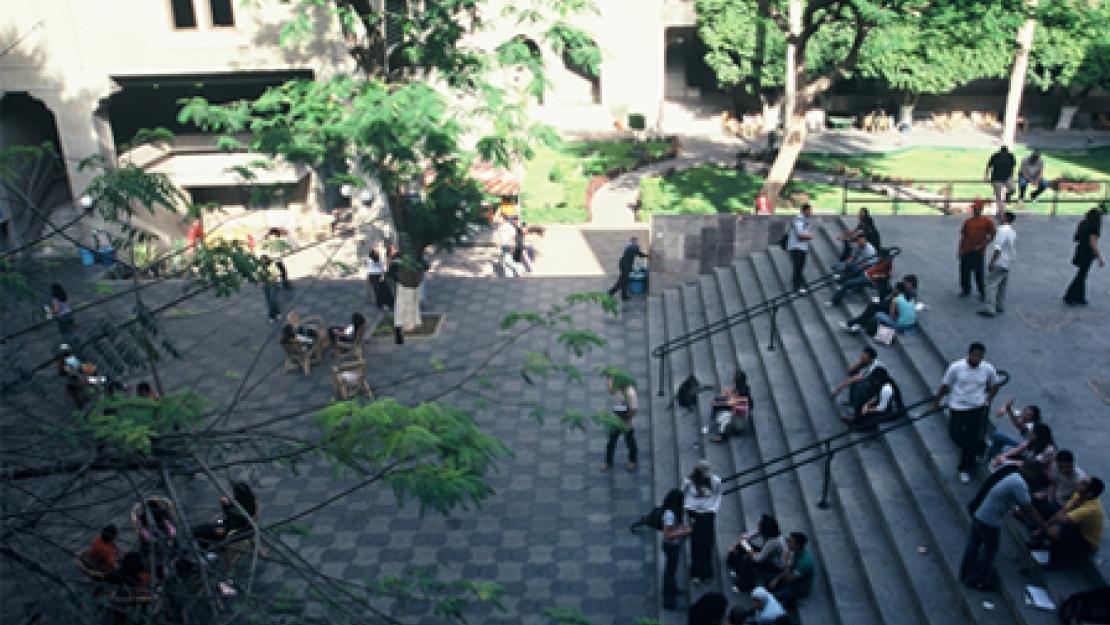
 Aziza Ellozy
Originally published on: November 23, 2004
“Spaces need to allow active learning; anything else is malpractice”
(Best Ideas, 2003 PKAL/NITLE Workshop on “Learning Spaces”)
Many universities in the US and elsewhere have designed or are in the process of designing new “learning spaces” to support new types of teaching and learning on their campuses. The shift in the design of these learning spaces is driven by changes in pedagogy and technology. AUC, with the building of our new campus, has had the unique opportunity of starting from scratch, and of taking advantage of the experience of others. It is also faced with the challenge of getting it right for at least the next ten years.
A month ago, a six-person team from AUC attended an intensive three-day workshop on “New Learning Spaces” held at Vassar University (NY), where an impressive group of experienced academics and architects led the formal sessions and provided individual consulting services to each of the participating teams. The workshop was organized by PKAL and NITLE, two organizations that have great experience in redesigning facilities in light of modern pedagogical requirements.
We approached the task with the knowledge that pedagogy, technology and facilities need to be integrated in a thoughtful and flexible way, and except for the two architects on board, most of us came to the workshop with little previous preparation. We learned a lot. We had many extemporaneous meetings and, among other things, we recognized the need for more communication with all stakeholders. With this spirit, I am writing this newsletter as a preliminary attempt to engage interested faculty in the discourse.
For the sake of clarification, “learning spaces” refer to “all spaces that accommodate the learning community”, and to “all facilities that enable people to learn and to teach”. In what follows, we will be focusing mostly on classrooms.
According to Brown and Lippincott (2003), the concept of the classroom is evolving and expanding. It is evolving as more emphasis on active learning and group work requires spaces that accommodate group interaction. It is expanding because technology allows the functionality of these learning spaces to expand, and to enable new learning activities and new methods of teaching and learning.
We learned that:
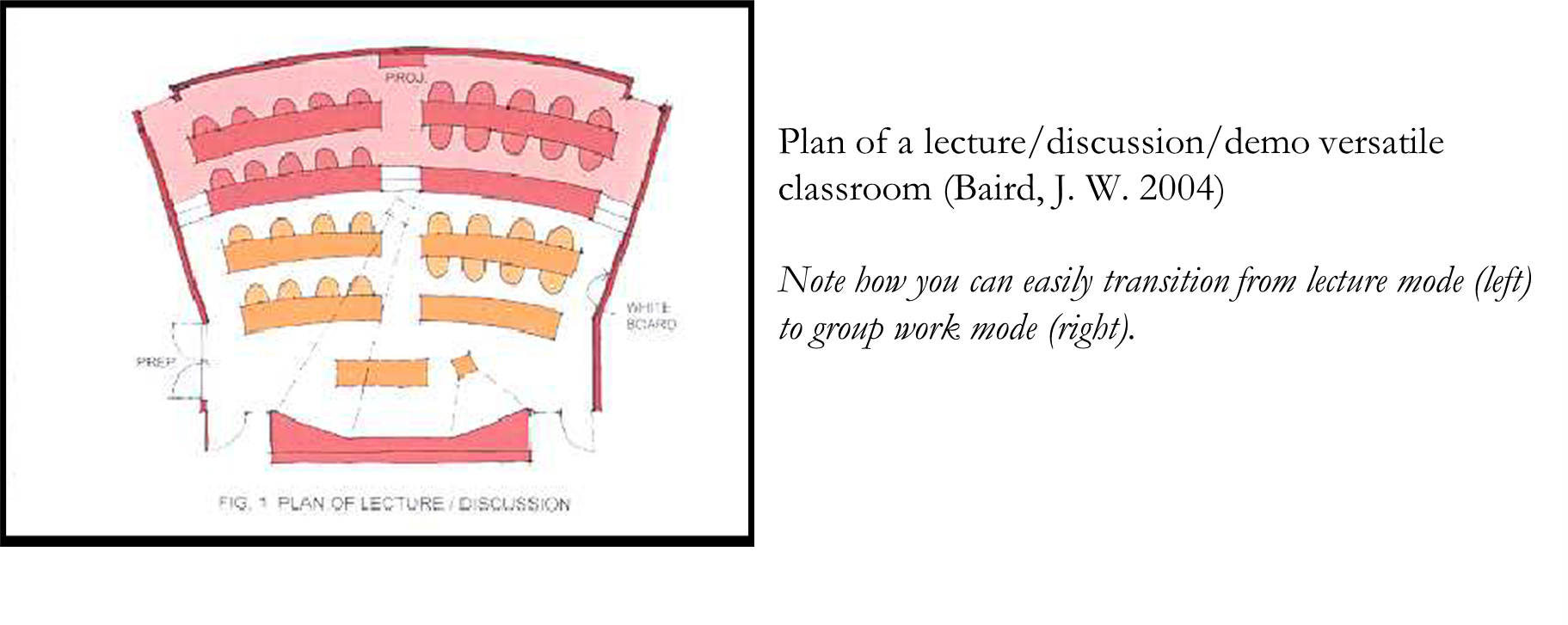
• In order for a teaching space to be effective it has to be either very versatile or very flexible . The most interesting information on classroom design that I came across is illustrated in the following drawing: in order to have students break up in groups of two, four or eight around a common table, an even number of rows is required.
• Technologies will change and rooms that serve the future must be ready for those changes.
• Faculty and students are relying more on handheld units such as laptops, tablet PC’s and PDA’s to access and manage their educational content. The emergence of mobile (portable) wireless technologies will allow spaces to be designed around pedagogical rather than technological needs.
• Students are increasingly encouraged or required to work in small groups, creating the need for more small group study areas. These are often places that are not moderated by an instructor and require access to technology.
• Before moving to our new campus, prototype mockup classrooms need to be constructed and “test driven” by students and faculty.
• A “sandbox” environment (room) needs to be created to research emerging technologies.
• Faculty offices should be thought of as small collaborative classrooms.
Sources
Baird, J.W., Holabird and Root LLC brochure. Distributed at 2004 NITLE- PKAL Workshop, “New Learning Spaces”, Vassar College, Poughkeepsie, NY. October 22-24, 2004
Malcolm B. Brown and Joan K. Lippincott.( November, 2003), Learning Spaces: More than Meets the Eye. Educause Quarterly. Found at http://www.educause.edu/942
