

 Aziza Ellozy and Hoda Mostafa
Originally published on: May 6, 2012
This newsletter is a follow-up on our last one where we described our experience with digital narratives within the context of a freshman course. We were, and continue to be, agreeably surprised by the quality of the narrative, the seamless integration of text, image and music, and in general by the hard work that the majority of students put into these projects. We were also quite impressed at how the students who, contrary to popular belief, had never used iMovie or Moviemaker, had never written a storyboard or drawn a concept map, could quickly to acquire these new skills without difficulty.
Feedback
To evaluate the impact of this type of project on students, we conducted an in class anonymous survey with clickers, to which 50+ students from two sections responded.
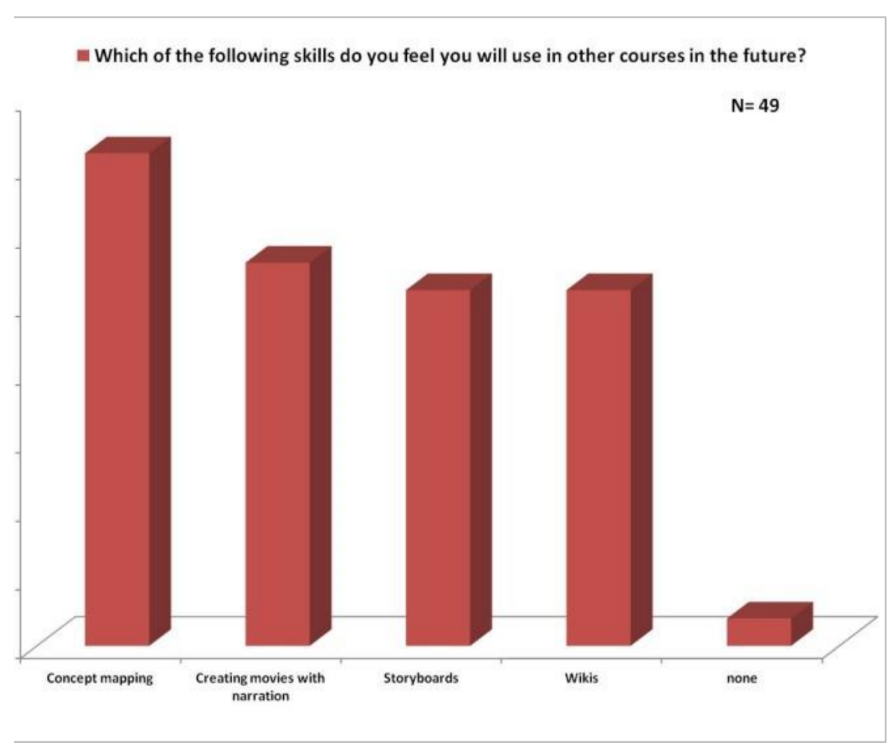
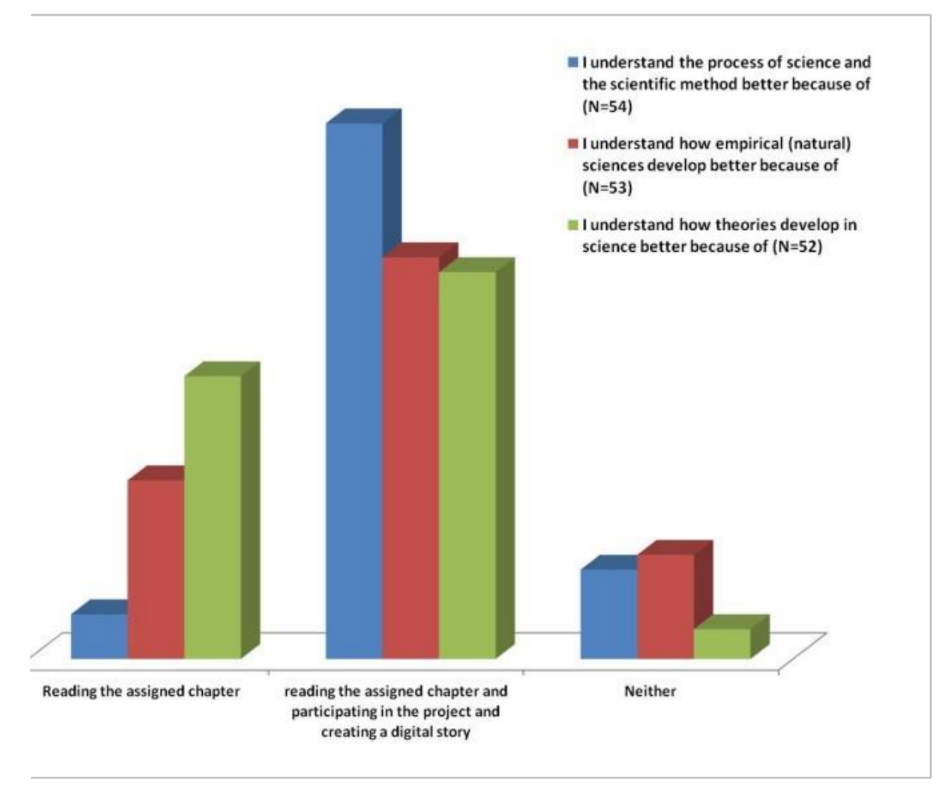
Some of the results are shown below.
Summarizing
- Our original objective was met: students recognized that by creating a digital
narrative of the assigned chapter they understood the process of science and the
scientific method better than if they had only read the chapter. - Students felt that working in groups was the most important factor that helped
them progress in the project including peer feedback and seeing others’ work. - Of all the skills that they learned (concept mapping, story boarding, creating
movies with narration, using a wiki) 37/49 students chose concept mapping as
the skill that they would use in other courses.
The students’ open ended comments fell mostly into three categories: the group dynamics, the nature of the project and the use of technology. A sample of these comments follows
Group dynamics
- “I could not have picked better partners and workers if I tried…I am pleased with our work and
our group, no one received the full load on their shoulders, no one slacked off or disappeared, and we worked well together. I want to thank the professor for the opportunity she gave us, as well as thanking my group for the remarkable work we produced together. This is really the first and only
group project of my university career that I have ever enjoyed so far. [ a senior] - “At this point in time I can really say I am proud of my group’s product. It was a project that
required using a lot of creativity and an opportunity to work in a group. However, I learned from this experience and other previous ones that teamwork does not always work well…This…reminded me of something I had learned in my Sociology class: social loafing…”
Nature of the project:
- “What I thought was going to be a long, hard project turned out to be something that I really
enjoyed doing and learning from, and would not mind doing again. So thank you
for a really great experience…” - “This was one of my favorite projects that I worked on this semester. What amazes me is
how a chapter in a book that might be described as boring by some people can be
turned into an interesting short movie”.
“the project has made us more attentive and interested in class because the class was
greatly related to the concepts in the chapter.”
Technology
- “This experience was very useful as it expanded our horizon of using technology.”
- [we learned about] “the vast services that are located here at the university, we
have met many helpful people who were more than willing to help us throughout the
whole process, especially the multimedia lab where we uploaded the video.”
A Final Comment
Faculty might be hesitant to introduce digital narratives into their curriculum if they fear their own lack of familiarity with technology will hinder their ability to guide and evaluatetheir students. However, the depth, quality, and clarity of a student’s work can be evaluated regardless of the medium (Ohler, 2009), and there are numerous resources on campus to assist both professors and students with new media projects. For teachers apprehensive about project evaluation, it can be helpful to establish and distribute a grading rubric prior to beginning the project, emphasizing the importance of content over flair16.1
Faculty might also hesitate because they fear such a project will be less intellectually rigorous than more traditional forms of assessment. But as Michael Coventry (2006) argues in his article Moving beyond the Essay: Evaluating Historical Analysis and Argument in Multimedia Presentations, “Like a successful research paper, a successful multimedia narrative project…is based on solid research and analysis and is the product of multiple drafts and revisions.”
As with any assignment, the level of difficulty is up to the teacher, and the project’s success should be predicated on the student’s mastery of the material.
Additionally, digital narratives have added benefits not necessarily found in essays and exams. Because of their narrative structure, students must contextualize their argument or analysis, and the process of selecting audio and visual components can stimulate creative synthesis. Many teachers (Oppermann, 2008; Leon, 2008) found that the medium– both more informal than a term paper and for students used to online content creation, more familiar – made students feel more confident or authoritative, and thus encouraged them to take imaginative risks. Finally, the structure and duration of these assignments
encourages students to slow down and engage the material in greater depth and with more purpose, while including peer evaluation discourages them from submitting something cobbled together at the last minute.
This form of learning assessment is infinitely adaptable, and has been used successfully in medical school (Sanders, 2009), science (Genereux, 2008), social studies (Opperman, 2008) and education (Borgelt, 2009).
CREDIT: a special thanks to Laura Delancey who helped us with the literature survey
SOURCES
Borgelt, Ida. “Using digital narratives to communicate about place-based experiences in science.” Teaching Science. 55.1 (2009): 41-45.
Coventry, Michael. “Moving beyond “the Essay”: Evaluating Historical Analysis and Argument in Multimedia Presentations.” Journal of American History. (2006)
Genereux, Annie. “Lights, Camera, Reflection! Digital Movies: A Tool for Reflective Learning.” Journal of College Science Teaching. (2008): 21-25.
Leon, Sharon. “Slowing Down, Talking Back, and Moving Forward: Some reflections on digital storytelling in the humanities curriculum.” Arts and Humanities in Higher Education. 7. (2008): 220-224.
Sanders, John. “Digital storytelling for reflection in undergraduate medical education: a pilot study.” Education for Primary Care. (2009): 441-444.
Ohler, Jason. “New Media Literacies.” Education Digest . 71.3 (2009): 31-36.
Oppermann, Matthias. “Digital Storytelling and American Studies: Critical trajectories from the emotional to the epistemological.” Arts and Humanities in Higher Education. 7. (2008): 171-188.
- 16 Should you wish to experiment with digital narrative projects, CLT can assist and support you in developing and implementing
such projects. ↩︎
Director Center for Learning and Teaching & Professor of Practice at the Center for Learning and Teaching