

 Aziza Ellozy
Originally published on: October 12, 2010
Last spring, I attended the School of Sciences and Engineering’s (SSE) retreat gathering in Alexandria, and as usual it was an inspiring and fun weekend. One of the items featured on the agenda pertained to “Faculty Development”, and since the Center for Learning and Teaching (CLT) is in the “faculty development” business, it was natural that I pay particular attention to what was going to be discussed. To my surprise, the only topic addressed insofar as my recollection goes, was the issue of faculty compensation (specifically with regards to differences in faculty benefits such as housing and school tuition based on national origin, passport status etc).
This was not the first meeting I attend where this term was used, but I did not pay much attention assuming that it referred to the more traditional interpretation of the term, namely the use of sabbaticals, the attendance of professional meetings, the availability of teaching and research grants and the like.
During the SSE presentation it dawned on me that, right now at AUC, “faculty development” has become synonymous with faculty compensation[1]. This is not only a very different interpretation of the term (the issue of salaries and benefits do not generally figure in faculty development programs), but it belittles the importance of the faculty development movement that has taken place in the last two decades. Recognizing the challenges that face the professoriate in today’s higher education landscape, many colleges and universities in the US (and elsewhere) have expanded the traditional responsibilities of such programs so as to include a much wider range of activities.
Using the broad definition of faculty development as the “organized support to help faculty develop as teachers, scholars and citizens of their campuses, professions and broader communities” [Sorcinelli et al 2006], let us examine the characteristics of “modern” faculty development programs and the factors responsible for expanding their roles and responsibilities. Let us also examine how AUC fares compared to other institutions and what we can do better.
This is a very broad subject which cannot be tackled in a short newsletter. Suffice it to say that the growing awareness in academia of the need for an expanded role for faculty development took a new urgency in the US in the late 80’s when a number of important reports (such as Integrity in the College Curriculum, Association of American Colleges and Universities, 1985) were critical of American higher education and called for reform and increased accountability.
This was also evidenced in the September 28th 2001 General Faculty meeting where “faculty development” appeared in the minutes of the Senate’s May 4th, 2010 meeting. It said: “Some things were addressed immediately but major points such as faculty development will take longer…” in response to the various fora that we had last year.
Concurrently, research on how people learn highlighted the need to shift the emphasis from what teachers do to what and how students learn, from emphasis on transmitting information to emphasis on students’ higher order thinking skills, from grading to learning outcomes assessment. Faculty were encouraged to redesign their courses, to adopt active learning strategies, to assess and evaluate student learning outcomes and to use new teaching and learning technologies effectively. Hence it is not surprising that faculty development as a field of practicefirst emerged as a means to assist faculty in their instructional efforts. This is when (late 80s to 90s) numerous institutions founded teaching and learning centers. At AUC, the CLT was established in 2002.
The educational landscape continues to change significantly and faculty are facing greater challenges to adapt to this new environment. What we are experiencing at AUC is typical: increasing competition, tightening of resources, demands for new skills, demands for increased research output, increase in number of students, demands for delivering a “world class” education and preparing our students for a “global” future, linking research to community problems or entrepreneurial activities etc, etc.
It is not surprising therefore that there is widespread recognition that faculty members need broader support in order to meet these growing demands. In Sorcinelli et al.’s words (2006) “colleges and universities committed to high productivity and quality will be well advised to situate faculty development at the center of their institutional planning” (p27).
What is this support they are talking about and what does it entail? The Professional and Organizational Development Network (POD), the premier US professional association devoted to faculty development, recognizes three approaches to an institution’s faculty development efforts. These are illustrated in the following flow chart.
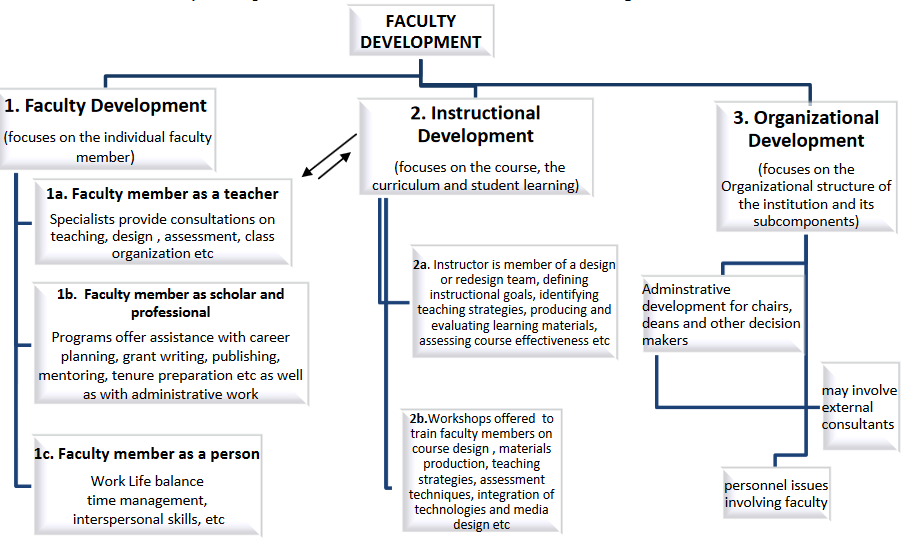
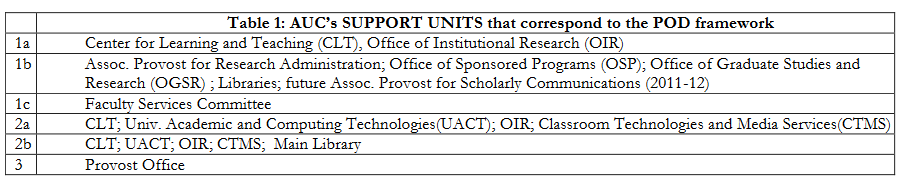
Using this framework as guideline, I would argue that AUC offers substantial (albeit dispersed) institutional support for faculty development which is comparable to any US institution that has made it a more intentional goal (see Table 1). Ideally this support should be tailored to individual faculty needs, a responsibility that could lie within the departments. The support that is glaringly missing is the pre-tenure mentoring for junior faculty. This and other important concerns have been expressed in the OIR report on 2009 fulltime faculty survey. Some have been addressed in recent initiatives such as the restructuring of the Provost’s office and the budding administrative “workshop” for chairs. Teaching loads and faculty compensation could very well be the next order of priority.
Sources:
Association of American Colleges and Universities, . Integrity in the college curriculum: a report to the academic community. 1st. Washington, DC: Association of American Colleges and Universities, 1985. Print.
Gillespie, Kay. A guide to faculty development., 1st, Bolton, MA: Anker Publishing Company, 2002. Print
Sorcinelli, Mary Deane, and Ann Austin. 2. Creating the Future of Faculty Development. 1st. Bolton, MA: Anker Publishing Company, 2006. Print.
“What is faculty Development?.” Professional and Organizational Development Network in Higher Education. Web. 11 October 2010. < http://www.podnetwork.org/faculty_development/definitions.htm
