 Aziza Ellozy
Originally published on: October 17, 2006
“If assessment is to improve the quality of student learning, and not just provide greater accountability, both faculty and students must become personally invested and actively involved in the process…Classroom Assessment aims to do just that by developing methods to bring the benefits of assessment into individual classrooms and under the control of individual teachers and learners.” (Angelo and Cross, 1993)
[Formative assessment] “occurs when teachers feed information back to the students in ways that enable the student to learn better, or when students can engage in a similar, self-reflective process.” (NCFOT, 1999).
In our last issue, we spoke of assessment as an essential process to improve student learning and to provide us with continuous feedback on the effectiveness of our teaching. We discussed how to write clear learning outcomes as a first step, and promised to follow up with a New Chalk Talk issue that would address the issue of collecting appropriate information in order to evaluate student learning[1].
To do this, we need to address two questions: what kind of feedback should be collected and how do we collect it?
Typically, feedback assessment information is collected using one of the direct and indirect methods shown in Table 1.
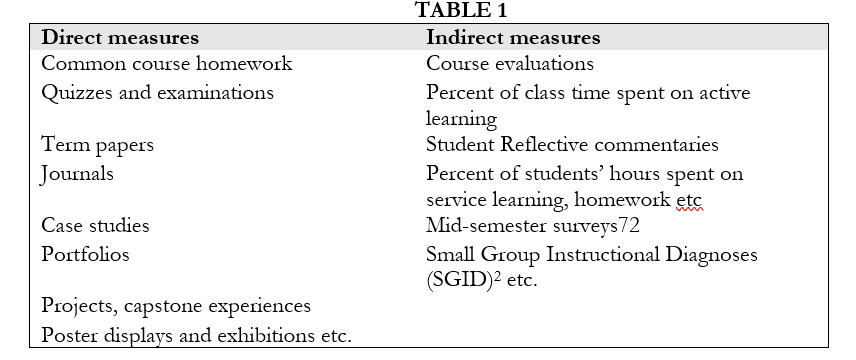
Direct measures judge student work and demonstrate actual learning, while indirect measures provide information related to the learning environment, the learning process, as well as to perceptions about learning. In most cases, there is not one ideal assessment method, and the best way is to diversify the assessment techniques. The question is which ones?
Choosing the assessment methods
So, which data do we collect and what do we do with it?
To answer this question, we need first to distinguish between two types of assessments: a) those that are formative – i.e., they occur regularly throughout the course and help faculty find out what students are learning in the classroom and how well they are learning it. Preferably, they should not be evaluative or involve grading of students; and b) those that are summative, which usually occur at the end of a learning module, semester, or year and are used to evaluate an individual student’s performance. Referring to Table 1, most of the direct measures are of a summative nature, and while they can be and are used to improve learning, they provide no evidence of why students learn or do not learn. Among the indirect measures, mid-semester surveys and Small Group Instructional Diagnoses are definitely formative assessments and allow faculty to quickly adjust content or approach based on students’ perceptions.
What we advocate here is Classroom Assessment as defined by Angelo and Cross (1993), which is one of the most noteworthy formative assessment approaches. The approach allows for a continuous classroom “feedback loop” where faculty collect feedback from students on their learning and then provide them with feedback and suggestions for improving it. Angelo and Cross (1993) have developed fifty such “Classroom Assessment Techniques” which are very effective. The most popular one is the Minute Paper, which has been described in a previous New Chalk Talk issue (Volume 1, Issue 2).
In summary, the steps would be to:
- Decide what you want to learn from a Classroom Assessment based on one of your learning outcomes (or on an assessable teaching goal as determined by your Teaching Goals Inventory. See footnote # 1);
- Choose any one of the “direct” assessment measures that provide this feedback or choose a Classroom Assessment Technique (CAT) that can be easily implemented in your class (see next New Chalk Talk issue);
- Explain the purpose of the activity to students and implement the task;
- After completion of the task, review the results and decide what changes, if any, to make;
- Let your students know what you learned from the exercise and how you will use this information;
- Have your students reflect on what they have learned and let them assess their own learning;
- Keep a record (recording and saving data electronically makes life much simpler!); and
- Adjust any necessary changes based on the results.
Our next New Chalk Talk issue will illustrate some examples of classroom assessment and how it can help us understand and improve learning.
Sources
Angelo, T.A, and P. K. Cross. Classroom assessment techniques: a handbook for college teachers. 2nd ed. San Fransisco: Jossey-Bass Publishers, 1993.
Middle Sates Commission, Student Learning Assessment Options and Resources. First Philadelphia: Middle States Commission on Higher Education, 2003.
Race, Phil. “Designing assessment to improve physical sciences learning.” September 20, 2006 http://www.physsci.ltsn.ac.uk/Publications/PracticeGuide/guide4.pdf
The National Center for Fair and Open Testing (NCFOT) (1999). The Value of Formative Assessment. Fair Test Examiner. Retrieved October 16, 2006, from http://www.fairtest.org/examarts/winter99/k-forma3.html
[1]Another very useful instrument that helps faculty identify their goals is the “Teaching Goals Inventory” (TGI), which can be found online at http://www.uiowa.edu/~centeach/tgi/background.html. This is a self- assessment of instructional goals which helps faculty identify the priority of the learning goals that they have developed (developed by Thomas Angelo and Patricia Cross)
[2] These are services offered by AUC’s Center for Learning and Teaching
