

 Nermeen Shehata and Moataz El-Helaly
Accounting does not always enjoy the best reputation among students. For many, the word immediately brings to mind numbers, complicated rules, endless calculations, and perhaps the dreaded words “debits and credits.” As accounting educators, we have often encountered students who approach their first financial accounting course with a mixture of curiosity and anxiety. Some even wonder why they need to study accounting in the first place!
For years, we have embraced active learning to challenge these perceptions. Rather than relying solely on lectures, we encourage students to discuss, solve problems, play games, and solve puzzles. More recently, we began exploring an additional question: What if artificial intelligence (AI) could help us make these experiences more engaging, interactive, and accessible?
Our exploration has taken us in several directions, from designing interactive learning activities using AI to encouraging students to critically evaluate AI-generated answers and providing supplementary learning resources in new formats. What started as an experiment has gradually become an opportunity to rethink how we teach some of the most foundational accounting concepts.
From Static Exercises to Interactive Learning Experiences
One of our challenges in introductory financial accounting is helping students master the fundamentals early in the semester. Concepts such as debits and credits, journal entries, T-accounts, and the accounting cycle are essential building blocks. If students struggle with these concepts, subsequent topics become increasingly difficult.
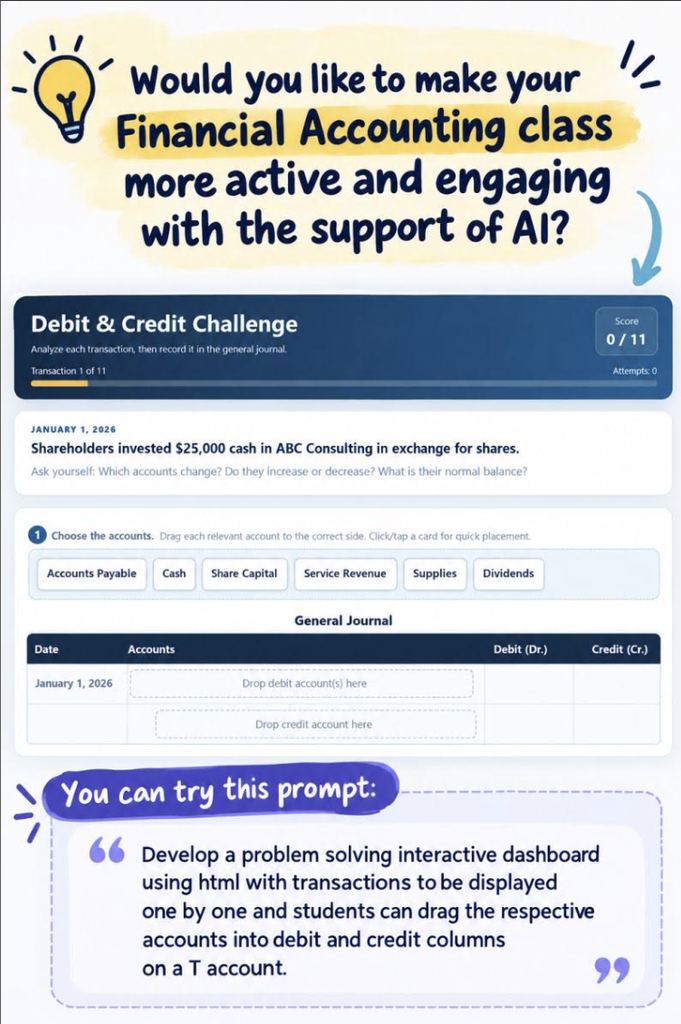
Prompt and Challenge’s Landing Page
Traditionally, students practice these skills by working through textbook exercises, completing worksheets, or solving problems on the board. These approaches remain valuable, but we wanted to add something different: interactive activities that allow students to experiment, receive immediate feedback, and visualize the relationships between accounting concepts.
Using generative AI, we developed several interactive HTML-based exercises that students can access through a web browser. Neither the underlying technology nor the idea of interactive exercises is entirely new. We have been following RichlyAnalytic1 for some time, and it was one of the main sources of inspiration behind this idea. What changed for us was how AI made it possible to create and customize these activities around our specific teaching objectives.
One example focuses on recording accounting transactions. Instead of simply completing a table of journal entries, students work through a series of business transactions using an interactive dashboard. They identify the relevant accounts, determine which accounts should be debited or credited, and drag their answers into the appropriate positions.
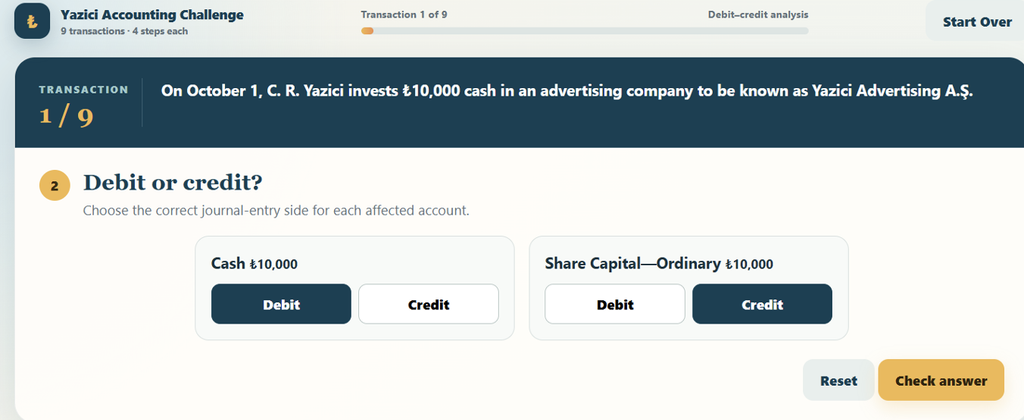
Transaction Analysis: Debit vs Credit
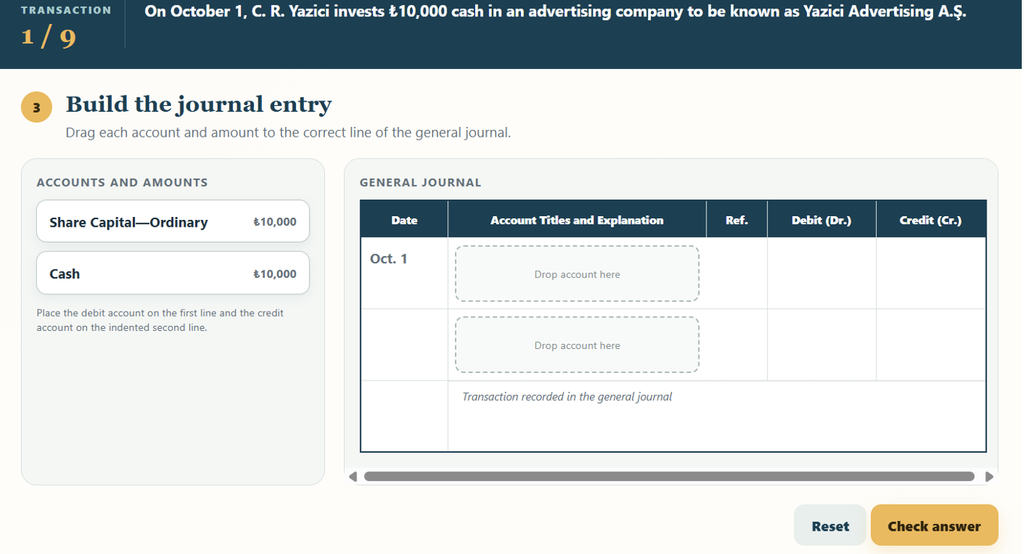
Record the Journal Entry

Post to T-Accounts
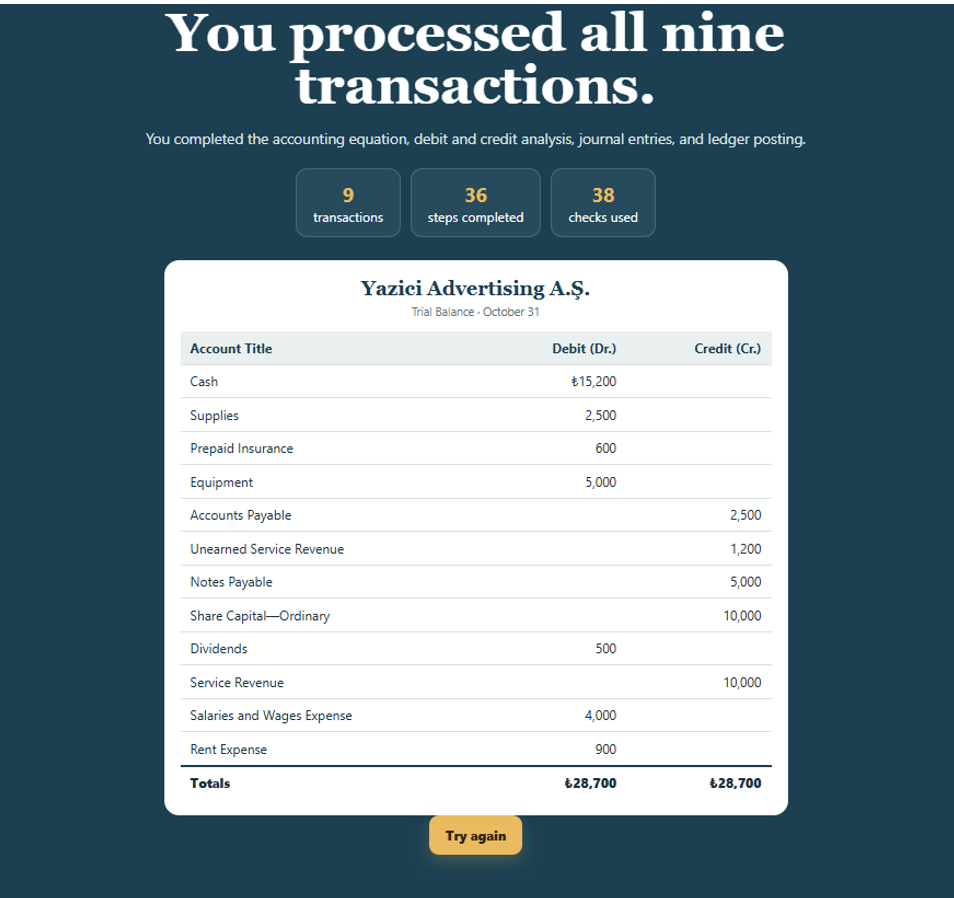
Review all steps through the Trial Balance
We experimented with different versions of the activity. In one version, students focus on constructing the journal entries themselves. In another, the journal entry is provided, allowing them to concentrate on transferring amounts to the appropriate T-accounts, calculating ending balances, and eventually preparing a trial balance.
The progression is intentional. Students move from understanding individual transactions to seeing how those transactions accumulate into a complete accounting system.
What makes these activities particularly useful is that students can immediately see the consequences of their choices. An incorrect classification is no longer simply a red mark on a worksheet; it becomes an opportunity to reconsider the underlying logic. We added to the prompt that students have to click ‘Check answer’ and they have to try again till they get the answer right. Once students get correct answers, they can then move to the next question. We also provide feedback after having the activity fully done in class.
We have also experimented with interactive visualizations of topics such as depreciation. For example, students can adjust assumptions and observe how different accounting methods affect the resulting numbers. Instead of memorizing formulas in isolation, they can explore the effects of changing inputs and compare alternative treatments.
Importantly, these interactive activities are not intended to replace traditional exercises. They provide another way to practice, discover patterns, and solve in pairs and discuss why an answer makes sense.
Giving Students More Ways to Learn
Not every student learns best from reading a textbook or reviewing lecture slides. Some prefer listening to explanations, while others benefit from visual illustrations or revisiting concepts at their own pace. Most benefit from a combination of these.
With this in mind, we have also experimented with Gemini Notebook (previously named Google NotebookLM) to generate short educational videos and audio discussions based on selected course materials.
These resources are then uploaded to Canvas as supplementary learning materials, allowing students to revisit foundational concepts outside the classroom.
We find the automatically-generated podcast format particularly interesting because it can turn a topic typically presented through definitions and calculations into a conversational explanation. Listening to two AI-generated (but seemingly very human) voices discuss an accounting concept may offer students a different entry point into the material. The tool also allows students to interact with the hosts, so that they can ask questions to the AI-generated podcast host and guest and receive answers.
Similarly, AI-generated videos can present ideas in a visually accessible format that complements our classroom explanations. Students can also, via Gemini Notebook, ask questions in text about the resources used to generate the podcast and video. It also allows students to create their own quizzes, flashcards, and mindmaps which could be of much help while studying.
We do not view these materials as substitutes for lectures, textbooks, or instructor guidance. Rather, they provide students with additional opportunities to engage with the same concepts through different formats.
Of course, AI-generated resources require careful review. We examine the content before sharing it, particularly because a convincing explanation is not necessarily an accurate one.
What Have We Learned Along the Way?
Perhaps our most important realization is that the value of AI in teaching depends less on the technology itself and more on the learning experience we design around it.
Creating an interactive exercise through AI is not simply a matter of entering one prompt and immediately obtaining a classroom-ready product. Our experience has involved repeated experimentation, revising instructions, testing activities, identifying errors, and adjusting the design to better align with our learning objectives.
Sometimes a version looks attractive but does not sufficiently challenge students. Another may work technically but introduce unnecessary complexity. The process has reminded us that good educational design still requires considerable instructor judgment.
We have also become more conscious of the importance of keeping students intellectually engaged. An attractive dashboard or entertaining video does not automatically lead to meaningful learning. What matters is whether students are required to think, make decisions, justify their reasoning, and reflect on what they have learned.
Although we have not yet systematically assessed the impact of these interventions on students’ academic performance, the experience has expanded our repertoire of teaching activities and opened up new possibilities for classroom engagement.
For us, AI is not replacing active learning; it is helping us experiment with new ways to support it.
A Small Invitation to Colleagues
While our examples come from financial accounting, we believe the underlying ideas extend well beyond our discipline.
The starting point need not be an elaborate technological project. It could be a single concept that students consistently struggle with, a traditional classroom exercise that would benefit from interactivity, or an alternative explanation that students can explore independently.
Our advice would be to start with the learning objective, experiment with the possibilities, and be prepared to revise. Most importantly, keep students’ thinking at the center of the activity.
We began with a familiar teaching challenge: How can we make accounting less intimidating and more engaging without compromising conceptual understanding?
We are still exploring the answer. But the process has reinforced something we strongly believe: The future of teaching lies in thoughtfully integrating human instruction and AI to enrich learning experiences.
And perhaps, along the way, we can convince a few more students that accounting is not quite as dry as they initially imagined!
AI Disclosure Statement
We used ChatGPT to help in the editing and proofreading of this article.
- RichlyAnalytic (https://richlyanalytic.wordpress.com/) is an educational platform that explores the use of generative AI tools, particularly ChatGPT and Copilot, to address accounting and business questions through interactive labs and case studies.
↩︎

Nermeen Shehata