

 Doris Jones
 Originally published on: April 18, 2014
We read to know we are not alone. – C.S. Lewis
Across cultures, reading behavior has been described in many languages: in French, goût de la lecture; in English, the love of reading, the habit of reading, or the desire to read; and in German, Leselust. How can AUC discover and promote a culture of reading within our community? How can students, faculty, librarians, administrators, and staff assist with promoting a reading culture to enhance the “first-year experience” for all incoming freshmen? One possibility is to implement a common reading program in which a discourse about reading is celebrated. Often described as a catalyst to establish intellectual community during a student’s academic career (Laufgraben 2006), common reading programs have been adopted by hundreds of colleges and universities in the United States. As an instructor in Rhetoric and Composition, it is increasingly apparent from classroom experience and from survey results produced by the Office of Data Analytics and Institutional Research (2013) that reading habits among AUC students are disconcertingly low. How can we increase the reading levels of our students while also addressing their attitudes about reading and other literary cultural activities? The inaugural launch of AUC’s One Book, One Conversation, One Community initiative is scheduled to begin with the fall 2014 freshman class. Such a program can put in motion an intentional partnership with learning communities across AUC that can help students achieve a heightened sense of the individual’s role in society
as well as acquire an awareness of diverse cultural perspectives to foster an academic year
of sustained conversations, collaboration and community spirit.

More than a Book Club
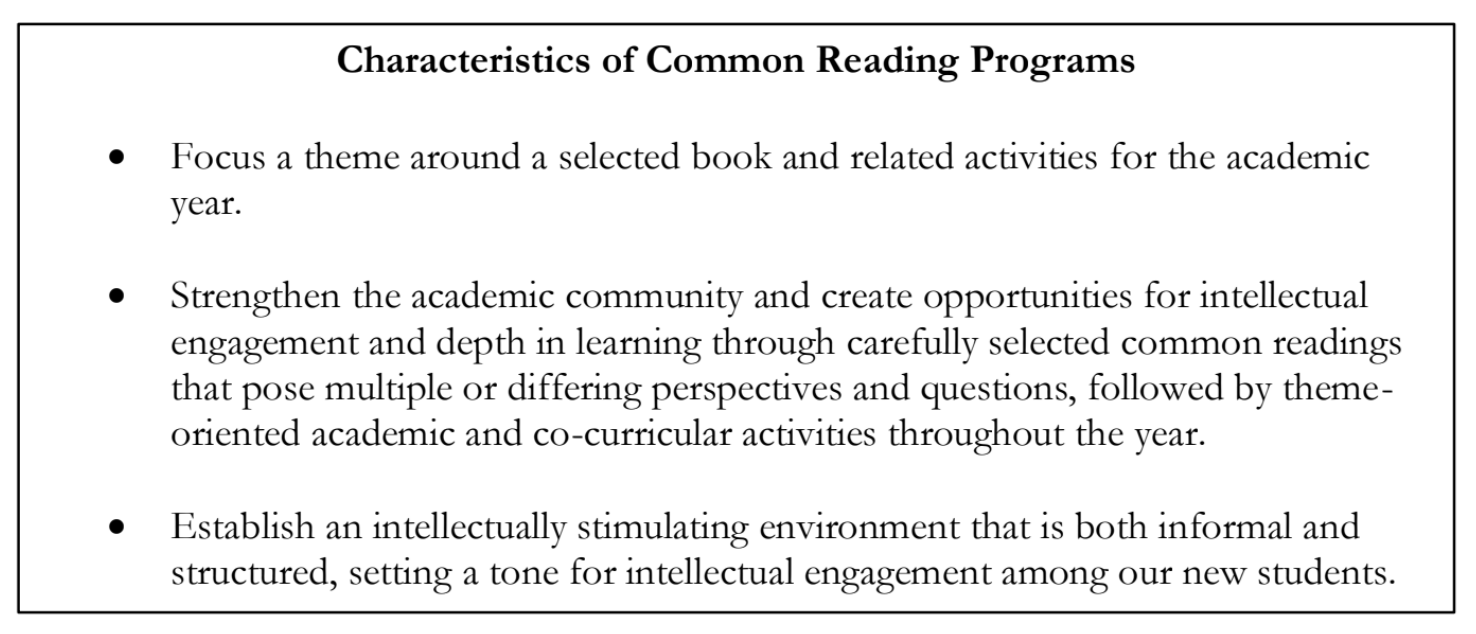
A central goal for a successful One Book, One Conversation, One Community reading program
is to harness an understanding of students’ interests, shared experiences, and the culture of learning, which is unique to AUC. When combined together, these factors can allow the university to move forward with a purposeful agenda to enhance its Freshman Year Program by encouraging all stakeholders to actively participate in the creation and sustainability of this important initiative. (See Table 1 below).
There exists a plethora of titles considered common reads; however, a major challenge AUC will face is choosing books that are of interest to our culture of learning here in Egypt. Books may often lose the “common” when closely examined for context, content, culture and environment. It is for these reasons that focus groups were organized last fall, and surveys were distributed to the AUC community to ascertain potential titles of interest. In addition, Selection and Implementation Committees have been organized to ensure an informed process is conducted by which a single text can be recommended for adoption.
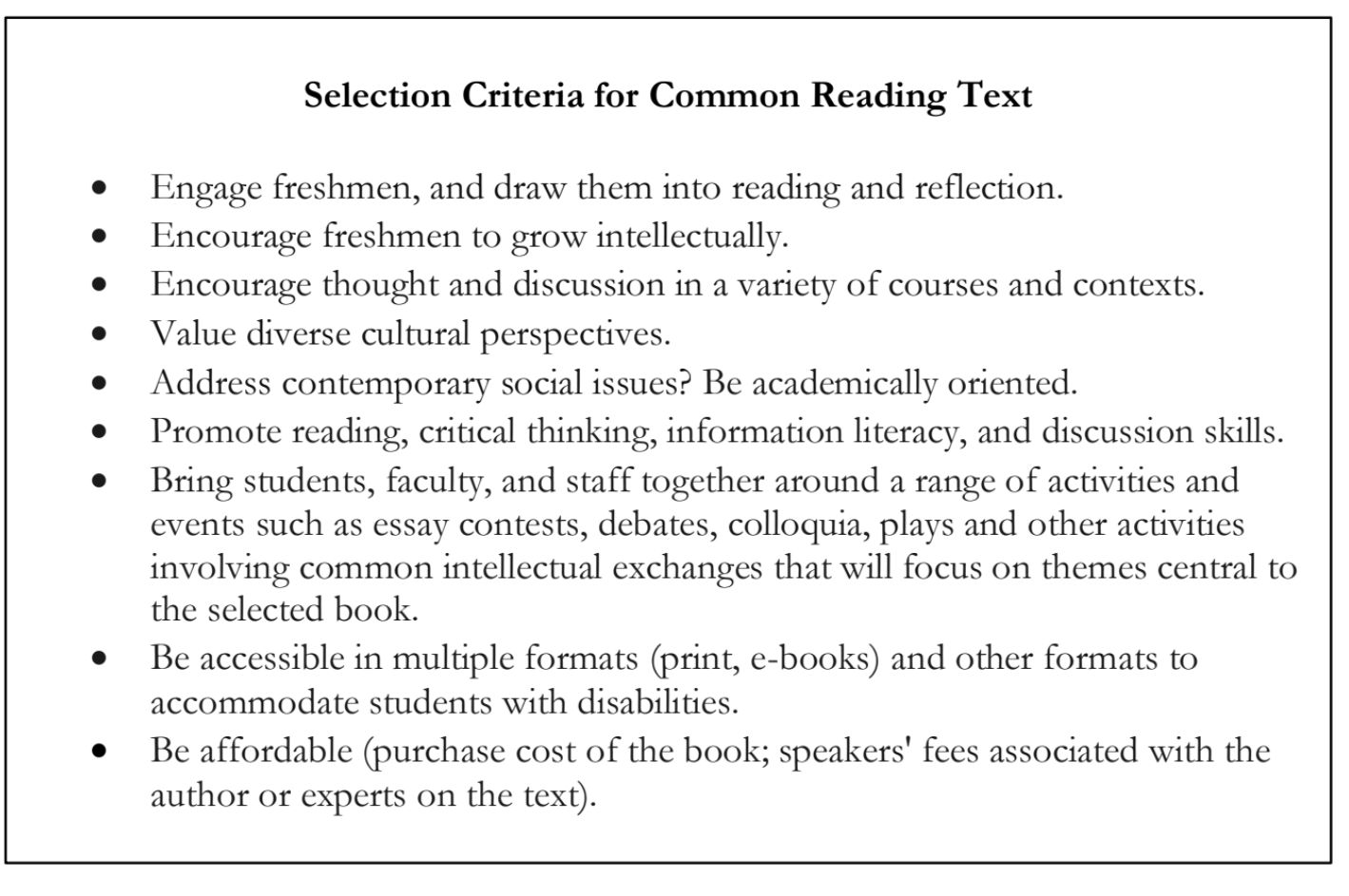
Following a critical review of countless common reading programs in the United States, far too many of the titles have engendered a “commercial” element, which has resulted in placing too much emphasis on inviting the “author” to campus. In this regard, the original purpose of the “common reading” objective, which is to enhance the first-year experience and beyond for entering freshmen, runs the risk of being lost. This critical review has also provided key insights into how the world of “common reads” may help us steer clear of these pitfalls that often cause such programs to fail. If we remain vigilant in interpreting
potential texts by connecting them to our students, our community, and our individual histories, we can choose texts that are culturally relevant to commence a community dialogue. (See Table 2 below).
References
Glasbergen, R. (2014). “Reading Is Fun!” Education Cartoons by Randy Glasbergen. Sherburne, NY.
Laufgraben, J. L. (2006). Common reading programs: Going beyond the book. University of South Carolina: National Resource Center for The First Year Experience and Students in Transition.
Report on the Results of the First-Time Freshmen Survey 2012. Data Analytics and Institutional
Research (DAIR) (2013). Cairo, EG: The American University in Cairo. http://www.aucegypt.edu/research/IR/assess/Effectiveness/Documents/First_time_Freshme
n_Survey_Report_2012.pdf
