 Pandeli Glavanis
 Originally published on: March 18, 2014
Student-centered teaching and learning have gained tremendous popularity among faculty
and students during the last two decades, and many courses seek innovative ways in which
students can enhance their own learning experience and gain new skills at the same time.
The emergence of new and innovative learning technologies has also contributed to this
process, and there is now a plethora of academic courses that make use of several such
technologies in the teaching process. Furthermore, higher education is also acutely
cognizant of the importance of the various new skills required by students for
them to secure rewarding employment after graduation. Along with the conventional
skills of literacy, disciplinary knowledge, and communication, skills such as digital
literacies, digital design, and familiarity with Web 2.0 tools have become additional
requirements. Nevertheless, faculty teaching in the disciplines do not have the time or in
many cases the expertise to teach these new skills as part of their courses. Joan Lippincott
(2007), however, argues forcefully that for such skills to be acquired by students, they need
to be integrated into the syllabus and enable students to acquire them while preparing
multimedia content as part of their assignments.
This short essay acknowledges the importance of Lippincott’s thesis and makes use of a
Classroom Action Research (CAR) project in an undergraduate course at the American
University in Cairo, in order to evaluate its application. The course, entitled “Social
Problems of the Middle East” required students to produce multimedia content as part of
their assignment,s and they were assessed on both the content and multimedia dimension
for the final grades.
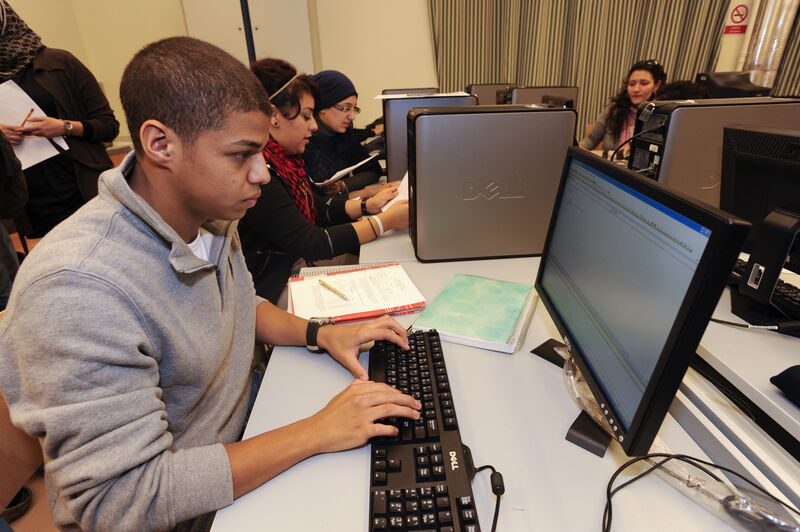
In order to achieve this objective, the course was structured around a close collaboration
between the faculty member teaching the course (Glavanis), a multimedia expert at CLT,
and the students. Appropriate Web 2.0 tools were identified, and the assignments were
designed to provide students with as much opportunity as possible to be creative in
producing content that expresses their learning in the course. Furthermore, the
multimedia expert provided Glavanis and the students with the IT support and the
appropriate in-class training. He also ensured that students were comfortable using the
Web 2.0 tools and found them “user-friendly”. This collaborative experience has been
monitored closely through a Classroom Action Research (CAR) project which is
reported below.
The objective of the CAR was to explore the use of a participatory and collaborative
approach in which students were (co)producers of learning materials (via a wiki). A quick
review of the existing literature showed that there were pros and cons in such a teaching
strategy. In particular, previous studies found:
Pros: Many educators argue that Web 2.0 tools provide richer and more engaging pathways to
learn with great potential for facilitating student multimedia content creation, interactive
information sharing, student-centered design and collaboration (Cochrane, 2010; McLoughlin
and Lee, 2008).
Studies suggest that students gain a better understanding of subject knowledge and develop
transferable skills while using Web 2.0 tools (Lee et al., 2006).
Cons: However, there are authors who believe that not all students may be familiar with
technology (Crook et al., 2008; Kennedy et al., 2007) and with some questioning the ideology
of Web 2.0, which they claim has not been seriously evaluated and has affected Pedagogy 2.0,
resulting in its failure (Williamson, 2009). (Teaching and Learning with Plymouth
University, 2012, p.3)
Thus, the CAR had a baseline from which to start the research and benchmark against.
Given the limited space available,e this short essay will only produce the results (of the
SGID? Survey?) in a summative form below.
- Students displayed mixed perceptions of producing multimedia content. The
majority enjoyed the experience of being challenged to work alone and create,
while a minority felt it was a frustrating experience; this was particularly with a
couple of mature students who noted, “As a mature student I felt extremely
disadvantaged.” - Of those who benefited from the experienc,e they highlighted the following:
a. Increased understanding of subject knowledge
b. Gained a sense of accomplishment
c. Enjoyed and benefitted from collaboration with peers – group work
d. Increased critical thinking skills and improved communication skills
e. Produced Iterative learning – “Can remember the course content better
than if I had just written an essay.”
f. Had fun and enjoyed learning
In general, we concluded that the experience was successful and worth repeating, while
taking into account student comments. Thus, student collaborative multimedia content
production as an alternative to traditional teaching and conventional forms of assessment
was justified and is now being used in all my teaching.
How Students used Multimedia technology to Study Abroad while staying at
Home
“Sometimes, when the place is dangerous or remote, a digital handshake is a viable path to global learning for college students.” (Cathy Youngmann, 2013)
Furthermore, in a different course where we collaborated via a wiki and Skype with
Cabrini College, Pennsylvania, USA, to produce anaward-winning multimedia object
(http://youthvoicesrise.com), additional benefits to those already noted above were
noted. As Cathy Youngmann, my colleague at Cabrin, I argued, “It seems that providing
students with the opportunity for global education experiences is currently a major
initiative in higher education. The benefits of preparing college students to become global
citizens through international contacts are obvious.” (Youngmann, 2013). Thus,
communication technology and multimedia content production also provide real
benefits when students are unable to travel abroad. Youngmann also notes that “the true
learning excitement took place during Skype interviews with students in Cairo” and “my
American students were quite moved by the personal life stories that their Egyptian peers
shared during individual video Skype sessions.” Youngmann concludes that “This was an
amazing experience for Cabrini students, who grew in their understanding of the Middle
East, of Islam, of journalism, of technology and about the importance of stepping out of
their comfort zones.” This also applied to Cairo-based students who were delighted with
the experience and in particular that the final output was a website entitled Arab
Awakening: A View from the Inside, which was awarded several prizes, including the prestigious 2012
Pinnacle Award for Best Multimedia Feature Presentation from the College Media Association, and
became available as a free e-book from iTunes.
In conclusion, it is possible to suggest from the above that collaborative student
multimedia content production is a teaching strategy with potential for engagement and
learning which also generates a variety of benefits for student learning. CLT provides
both pedagogic and technical support for any faculty wishing to take on this challenge.
References
Lippincott, J. (2007). Student content creators: Convergence of literacies, EDUCAUSE, November-
December, p. 16-17.
Teaching and Learning with Plymouth University (2012). Students as producers of multimedia content:
Challenges and opportunities of pedagogy 2.0. Retrieved from:
http://www.thailandpod.net/thaipod_joomla2/documents/iced2012/ID65.pdf
Youngmann, C. (2013, January 17). How students used technology to study abroad while staying
home, Media Shift. Retrieved from: http://www.pbs.org/
