

 Pandeli Glavanis
 Originally published on: November 6, 2013
In part 1, I argued that educating citizens, and especially critical citizenship, has to become an AUC priority, and this must be discussed and debated at all levels of the Institution. In part 2, I propose to present some specific suggestions that may facilitate such a discussion and, in particular, address the way in which such concerns can be embedded in the curriculum through Community-Based Learning. I start with a couple of critical points noted by the Association of American Colleges and Universities 2012 report, referred to in part 1, which highlights the fact that what is needed is not traditional civic classes as
such, but the need for students
…to understand the cultural and global contexts in which democracy is both deeply valued and deeply contested. Moreover, the competencies basic to democracy cannot be learned only by studying books; democratic knowledge and capabilities are honed through hands-on, face-to-face, active engagement in the midst of different perspectives about how to address common problems that affect the well-being of the nation and the world. Civic learning that includes knowledge, skills, values, and the capacity to work with others on civic and societal challenges can help increase the number of informed, thoughtful, and public-minded citizens. Civic learning should prepare students with knowledge and for action in our communities. (AACU, 2012:1)
Thus, the report becomes an advocate of what, in pedagogical terms, we refer to as Community-Based Learning. The report also recognizes that such an academic endeavor also contributes to the development of other generic skills among students, which in turn enhance critical citizenship. For example, it highlights the following skills:
➢ Critical inquiry, analysis, and reasoning capacities;
➢ Quantitative reasoning;
➢ Gathering and evaluating multiple sources of evidence
➢ Seeking, engaging, and being informed by multiple perspectives;
➢ Written, oral and multi-media communication;
➢ Deliberation and bridge‐building across differences;
➢ Collaborative decision‐making skills;
➢ Open‐mindedness and capacity to engage different points of view and cultures;
➢ Civic problem‐solving skills and experience;
➢ Civility, ethical integrity, and mutual respect;
➢ Integration of knowledge, skills, and examined values to inform action taken in concert with other people;
➢ Public problem solving with diverse partners; and
➢ Compromise, civility, and mutual respect. (AACU, 2012: 3)
The skills highlighted by the report are fundamental to Community-Based Learning, but can also be integrated into a variety of courses across the curriculum. To do so not only enhances critical citizenship but also high-quality scholarship and academic vigor. Thus, it is impossible to think that any professional academic would not agree to incorporate such skills in their respective courses. However, this may require some fine-tuning of a syllabus in order to incorporate such skills in the learning outcomes and to
identify appropriate methods to evaluate them. For example, “written, oral and multimedia communication” can swiftly be integrated by expecting students to make oral presentations and produce multimedia assignments alongside the conventional essays and/or exam question answers. Admittedly, this presupposes a move away from “multiple-choice” examinations, but the learning rewards for students are too significant to be ignored.
Furthermore, the report also highlights the results from a major study conducted in the USA in 2009, which notes that the percentage of college students who “strongly agree” that contributing to the community should be a major focus of college is significantly higher than those who admit that it actually is. (AACU, 2012: 5)
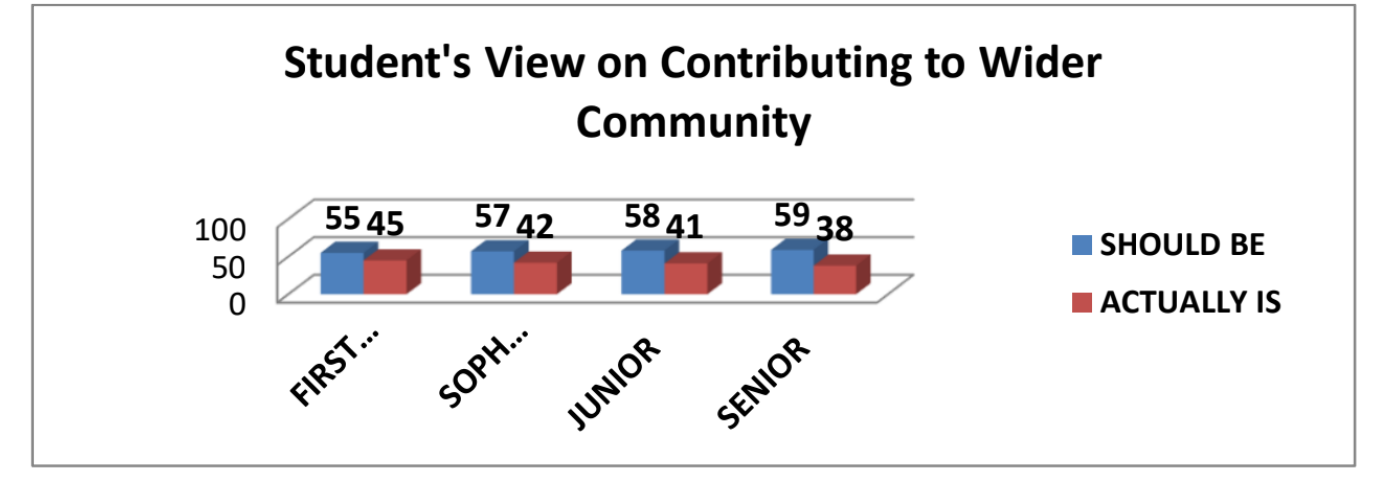
The table above suggests that students are keen on Community-Based Learning, but academics tend to shy away from it in favor of conventional theoretical and conceptual teaching and assessment. Furthermore, the drop in percentages from 45% in First Year to 38% in Senior Year of what is actually done also indicates that faculty in senior courses tend to emphasize even more conventional scholarship and learning strategies in order to produce first-rate scholars to the detriment of critical citizens. Thus, in conclusion, let me agree with Deardorff and Kupanda (2012: 345-46), who highlight the fact that the
ultimate goal of education is to produce “a more just society” by reminding us of education theory ranging from John Locke’s comments in Two Treatises of Government to Paulo Freire’s Pedagogy of the Oppressed. Democracies need active, informed, and responsible citizens; citizens who are willing and able to take responsibility for themselves and their communities and contribute to the political process. AUC can produce such citizens through Community-Based Learning and contribute to Egypt’s struggle for a democratic future.
Sources
Association of American Colleges and Universities (2012). A Crucible Moment: College Learning
and Democracy’s Future, retrieved from: http://www.aacu.org/civic_learning/crucible
Deardorff, Michelle and Kupanda, Angela Mae (2011). Negotiating Social Mobilization and
Critical Citizenship: Institutions at a Crossroad. University of Florida Journal of Law and Public
Policy, 22: 335-360.
