
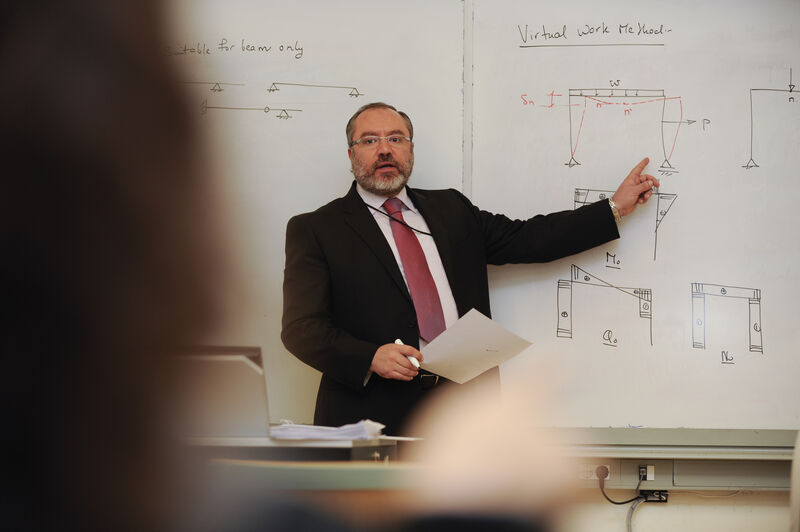
 Dr. Pandeli M. Glavanis, Associate Director, Center for Learning and Teaching
Originally published on: April 8, 2008
Continuous evaluation and assessment of courses, programs, degrees and even entire academic institutions is part of the course in modern educational systems. A key component of this process is learning outcomes, and as such, they have been seen by many academics as belonging to the realm of “obligatory” activities that we all need to engage with in order to receive the much-valued accreditation. Thus, academics in general express a degree of disdain when asked to either clarify them or, even more so when told they have to use them. Learning is still seen in many institutions of higher education as part of a “mystical” process that takes place within the hallowed environment of the academy and not a discreetly quantifiable activity that can be paraded to outsiders and even internal committees for them to be assured that we, the faculty, are doing our jobs well. In short, learning outcomes have not received a very good press. Faculty do engage with them, but albeit reluctantly.
It is, of course, beyond the scope of a short essay, to try and correct what I firmly believe is a serious misconception, or for that matter to seek to identify the reasons behind the misconception. The latter, in particular, is definitely worthy of serious debate as it resides firmly within the broader landscape of what is learning and how does it happen. It is the age-old terrain within which numerous debates, related to the cognitive process of how critical thinking is enhanced, have taken place. There are those that still advocate the didactic approach and those that see self-learning and critical thinking as being enhanced by “facilitators” rather than teachers. Learning outcomes are a key component in this debate even if academic managers have now appropriated them for purposes of assessment and accreditation. In other words, I would argue that learning outcomes preceded current systems of assessment and accreditation and derive primarily from the long-standing debate of what is the best teaching strategy that does enhance critical thinking, and thus learning. Let me explain.
First, let us clarify what learning outcomes are not, as this is one of the key misconceptions held by many faculty. They are not a description of the content or the syllabus of a learning unit (course, module, or even program and degree). Neither are they what faculty intends to do or convey in such a learning unit. Furthermore, they are not to be confused and/or identified with learning objectives, which are also highly valued components of a learning unit. Objectives set out in unambiguous terms the content that is to be integrated into the learning process and thus the generic skills, knowledge and understanding that the student needs to achieve and possess by the end of a learning unit. For example, at the end of a metallurgy learning unit, a student needs to be cognizant of the fact that different metals also exemplify different properties and how these differences can be used in the process of constructing an edifice, a bridge, etc. Similarly, at the end of a language learning unit, a student needs to demonstrate the ability to write grammatically correct sentences and make use of a certain pre-defined level of vocabulary. Learning outcomes, on the other hand, focus primarily on the learner and identify the cognitive
and experiential capabilities needed in order to achieve the learning objectives. Thus, for example, they highlight the critical thinking skills as well as generic skills needed by the learner in order to grasp both cognitively the chemistry of different metals as well as their potential use in construction (i.e. applications).
It is in this respect that learning outcomes achieve their educational and learning significance for both faculty and learners. Furthermore, it is in this area that the exciting and interactive process of learning takes place. For faculty, for example, identifying learning outcomes is the foundation stone on which the learning unit syllabus, content, objectives, assessment, and teaching strategy (methodology) are defined. Let me explain.
Content / Syllabus: If faculty requires a certain type of cognitive skill to be acquired, then they also need to provide the content which will enable learners to understand such knowledge. For example, it is not sufficient to provide content that identifies and lists the different properties of metals and how these can be used in different types of construction. It is also necessary to provide content that spells out in some detail the chemistry of these different metals as well as how this can be changed in order to meet the requirements of different types of construction. In other words, it is the difference between rote memory learning of properties and their concomitant application and critical thinking learning, which enables a transformation of properties and thus, a variety of alternative applications. The latter, of course, is a higher level of learning and requires a different form of engagement of the learner with different types of content: chemistry.
Learning Objectives: If faculty requires learners to be able to demonstrate ability in how different metals can have their properties transformed in order to meet different and/or innovative requirements in applications, then the objectives set will differ significantly from a learning unit where learners are only expected to demonstrate ability of how to make use of different metals in pre-defined forms of construction.
Assessment and Evaluation: If faculty requires learners to demonstrate abilities in higher levels of cognitive knowledge, then they will also have to devise assessment tasks that reflect this. For example, in the case of a metallurgy learning unit, they would also have to give learners tasks that involve the chemistry of metals and how these can be transformed in order to be used in certain types of applications. This, of course, is not required if the learning outcome is the simple application of certain metals, whose properties are already given and known, for the construction of certain pre-defined objects.
Teaching Strategy / Methodology: if faculty requires learners to demonstrate higher levels of cognitive skills (critical thinking), indicated above, then assessment tasks and learning activities will differ significantly from those requiring simple applications of knowledge.
The above highlights the fact that it is the learning outcomes that ultimately determine the learning unit’s design, content, syllabus and teaching strategy. In effect, the learning outcomes “telegraph” to the learners and academic managers the qualitative differences in learning between learning units and thus also enable intellectual progression and academic standards to become both transparent and measurable. Furthermore, the specific derived hierarchy of cognitive skills and their concomitant generic application skills also enable learners to assess their own knowledge and capabilities. They enable learners to set targets and identify strategies for how to meet such targets. Thus, for example, some learners may wish to achieve the basic target of constructing via the use of materials whose properties are already known. Other
learners, however, may wish to develop the skills of how to transform the properties of materials in order to meet the ever-changing requirements of modern living. Learners will identify which learning unit they will take through a careful understanding of learning outcomes and not learning unit objectives.
Learning outcomes, therefore, are and should be seen as being the intellectual foundation stone on which learning units are developed and designed. They are, in my view, the most exciting and challenging element of teaching and in effect the most dynamic and interactive dimension of learning. Their appropriation by academic managers for assessment and accreditation should not detract from their generic value as a key element in the learning process. For both faculty and learners, they are also the mechanism by which knowledge and/or generic skills are developed and transformed, and thus the progress of episteme is assured.
Sources:
Biggs, J. 1999. ‘Formulating and clarifying curriculum objectives [Ch. 3]. In Teaching for Quality Learning at University. Society for Research into Higher Education and Open University Press. Buckingham, UK.)
