

 Doris Jones Writing Instructor, Department of Rhetoric and Composition
Originally published on: November 1, 2011
A new academic year can present opportunities for faculty to investigate and implement electronic teaching and learning resources that may assist with one of the most time-consuming aspects of instruction – assessment of our students’ written work. In Rhetoric and Composition and in other disciplines, formative assessment tools are frequently used since our students are engaged in the “complex performance of writing” (Kalantzis et al., 2011), which is an integrative process involving the presentation of arguments, reasons, evidence, and consultation with theories for research purposes. This “complex performance” also means our students are producing written products across a variety of subject areas that require working in “communities of practice” or “discourse communities” (Lave et al., 1991) to achieve higher-order thinking skills (Etkina et al., 2005). A technology-mediated assessment tool capable of canvassing such an academically rich environment is yet to evolve. Turnitin.com’s GradeMark, PeerMark and WriteCheck are some of the digitized tools that have become prominent fixtures in higher education. As these mechanized teaching resources proliferate, we must consider critically to what extent they are improving the assessment process while also fostering an environment in which our students are learning. Emphasis should be placed on the type and quality of feedback students receive for their written work. Accordingly, in what ways can digitized writing assessment tools provide clear learning objectives while also interpreting student performance? Are digitized assessment tools presenting false expectations for instructors and students? These are valid concerns that appeal to various stakeholders. In this increasingly digitized environment, many instructors have moved away from paper and pen assessment, but where are we going? As educators, it is our responsibility to investigate assumptions about digitally mediated writing assessment technologies to determine what these resources can actually do to promote learning and critical reflection.
This fall, I became reacquainted with GradeMark, a Turnitin.com application that has removed the drudgery of downloading and saving papers as MS Word files to my computer’s hard drive. GradeMark’s digital environment allows instructors to access a student’s paper as well as comment and assign grades in one location. Some of the other highlights of this electronic assessment tool include:
- Ample space to write general comments about the student’s paper.
- A rubric feature, a very nice addition for faculty who opt for such a document to accompany the first draft comments or final graded paper;
- Consistent use of relevant terms when common errors occur;
- A digital work environment our students are already familiar and comfortable with;
- Help with identifying issues in language, grammar, and punctuation through accumulated reports
The General Comments shown in the graphic below were designed to help the student recognize how argumentative writing involves the integration of support to advance claims. Understanding how students conceive writing as a process can also help determine when and how writing knowledge transfer occurs in academic contexts (Lave et al., 1991), legitimizing writing assessment as core teaching and learning objectives.
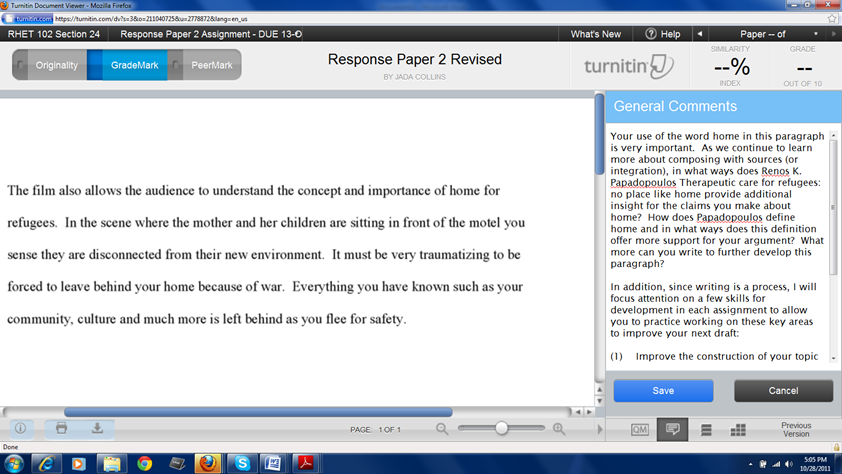
Figure 1. GradeMark Assignment and Formative General Comments
As a rule, writing assessment must be reliable and valid to guide students to critical reflection. Reflection is viewed as a higher-order, meta-cognitive skill our students must become familiar with. Once these skills are acquired, however, they must be assessed. In her text, Reflection in the writing classroom, Kathleen Yancey (1998) defines three types of writing reflections:
- reflection-in-action, the process of reviewing, projecting, and revising, which takes place within a composing event and the associated texts;
- constructive reflection, the process of developing a cumulative, multi-selved, multi-voiced identity, which takes place between and among composing events, and the associated texts; and
- reflection-in presentation, the process of articulating the relationships between and among the multiple variables of writing and the writer in a specific context for a specific audience, and the associated texts.
Yancey is an advocate for instructional methods that encourage students to take ownership of their texts. She claims that instructors have often conscripted the text of their students in an attempt to pass “judgment” or to assess them. With these points in mind, instructors must design assignments that best convey GradeMark’s pedagogical potential. As Turnitin.com and its related applications become more ubiquitous and preferably less punitive, we must encourage our students to see themselves as active stakeholders who can validate our use of these assessment tools since transparency and accountability remain prominent issues in higher education.
References
- Etkina et al. (2005). The impact of the cognitive revolution on science learning and teaching, James Royer, Editor, The impact of the cognitive revolution on educational psychology, Information Age Publishing, Greenwich, CT (2005).
- Kalantzis, M., McCarthey, S., Vojak, C., Kline, S. (2011). Technology-Mediated Writing Assessments: Principles and Processes. Computers and Composition, 28(2), 79-96.
- Lave et al. (1991). Jean Lave and Etienne Wenger, Situated learning: Legitimate peripheral participation, Cambridge University Press, Cambridge, UK.
- Yancey, K. B. (1998). Reflection in the writing classroom. Logan, UT: Utah State University Press.
