

 Gihan Osman
 Originally published on: May 16, 2013
Although blended learning is believed to combine the best of face-to-face and online instruction, achieving the right blend from the pedagogical and practical perspectives adds a level of complexity that is unique to this mode of instructional delivery.
The design or re-design of a blended course can be accomplished by the course instructor. However, it is often recommended to undertake this project in collaboration with a team that can support the design and development process. Some typical members of such a team are: instructional designers, multi-media specialists, a librarian, etc.
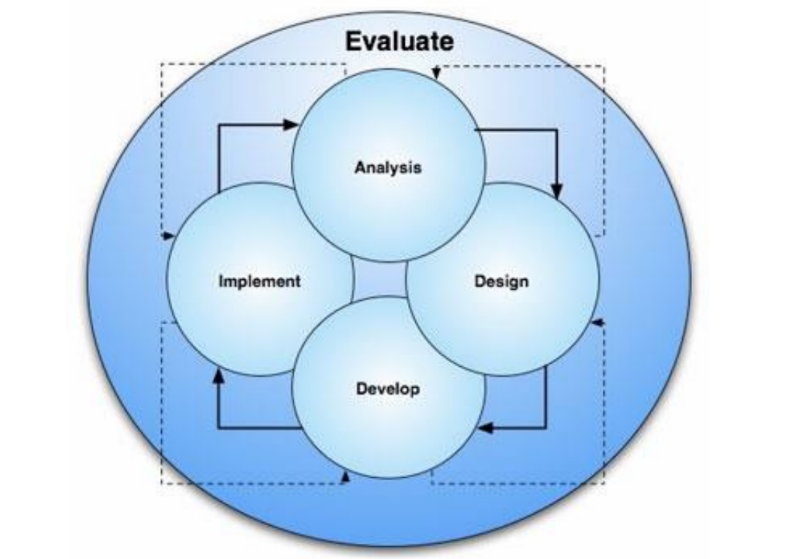
The design and development process could be formal or less formal. However, it is usually iterative in nature and often entails a number of phases that ideally happen in sequence, but are often combined and occur simultaneously for practical considerations. One of the models that is often used to envision the process is ADDIE model for the design of instruction, which consists of 5 phases: 1) Analysis; 2) Design; 3) Development; 4) Implementation; and 5) Evaluation (Dick and Carey, 2001). Figure 1 depicts one of multiple visual representations for this model.
Figure 1. The ADDIE model for the design of instruction (Clark, 1995)
Analysis
During this phase, the instructor, alone or in collaboration with the design and development team, defines the goals for the blended course. It is also the stage at which the learners’ needs are carefully considered. Some of the issues to examine in that regard are the learners’ goals, their existing knowledge and skills in terms of the subject content, their language and technology competencies, their access to technology and other relevant resources, their cultural and educational background, their previous experience with online instruction, possible learning challenges, etc. It would also be important to focus on the instructor at this point in terms of their reason for choosing to go blended, their teaching
philosophy and strategies they have used in teaching face-to-face classes, their comfort and skill with different technologies, etc. Some organizational factors to think about at this stage are the financial resources allocated for the course, the available forms of technical and administrative support, the technologies supported by the school, the possible constraints, etc.
Design
The design phase is backbone of the process. It should be deliberate and detailed. It usually starts as a close consideration of the course outcomes and learning objectives, and the assessments used. This is usually followed by a consideration of the learning activities and strategies that would facilitate the achievement of outcomes and objectives. The integration of the face-to-face and online components is carefully considered. Technologies that will facilitate the course activities will also be decided upon. This phase often results in a number of additional deliverables that focus on design plans for communication and interaction within course, the interface and visual design of the course as well as prototypes and storyboards that demonstrate the elements of this design to the instructional developers later on.
The challenge for designers is to create a course that demonstrates effective instructional strategies that not only focus on low level cognitive skills but that help learners engage in higher order thinking skills such a problem solving, critical thinking and creativity (Moore & Kearsley, 2004). It is also important to consider affective factors in the design of instruction to maintain learner motivation and commitment
Development
The phase is often undertaken by instructional developers and graphic designers who translate plans resulting from the Design Phase into instructional materials that help learners achieve the learning outcomes. This also the stage at which the training of instructors or/and teaching assistants takes place (Moore & Kearsley, 2004).
Implementation
The phase entails the actual delivery of the course to students that is implemented according to the plans outlined during the Design Phase. Training students to use new technologies utilized during the course often takes place at the beginning of this phase.
Evaluation
Evaluation and subsequent revisions are essential embedded activities during ADDIE, and continuously take place during different stages of the design and development process (See Fig 1). Additional forms of formative and summative evaluations are integrated during the implementation or delivery of the course. These inform future revisions on the course, but might also influence departmental and university-wide decisions regarding blended learning.
References
Clark, D. (1995). Why Instructional System Design? Retrieved from: http://www.nwlink.com/~donclark/hrd/sat1.html
Dick, W., and Carey, L. (2004). The Systematic Design of Instruction (5th Ed.). Boston, MA: Allyn & Bacon.
Moore, M. & Kearsely, G. (2004). Distance education: A systems view (2nd ed.) Boston, MA: Wadsworth
Publishing.
