
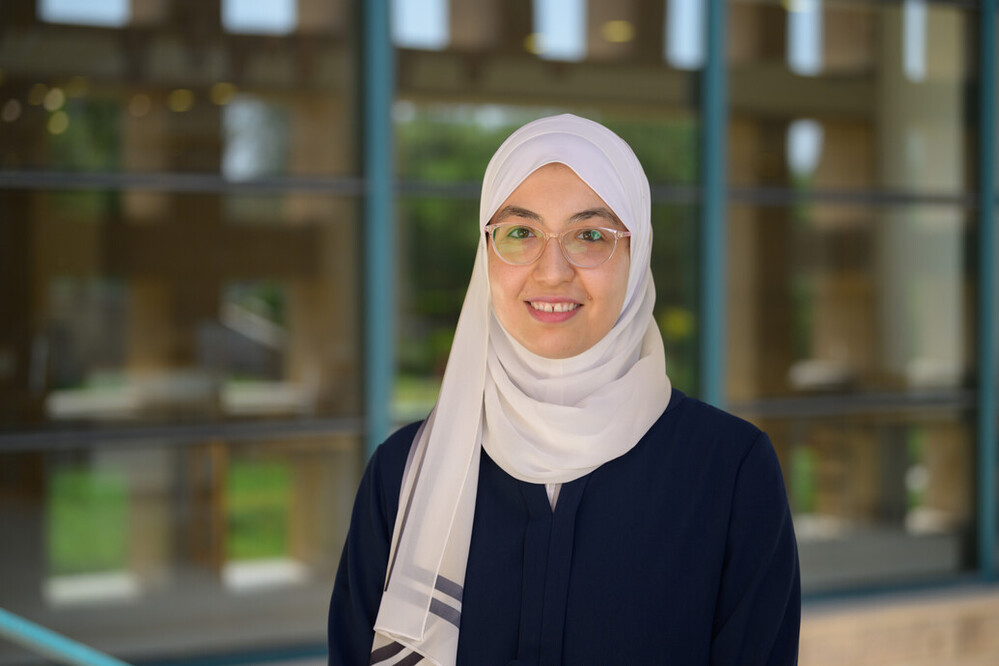
Course Name: Applied Data Structures (CSCE 2211)
Instructor: Dina Mahmoud
Course Description: The Applied Data Structures course provides students with in-depth knowledge of data structures used to organize and operate on data in modern computing systems. It helps them compare between data structures and algorithms to choose the most suitable for an application and its requirements.
Redesigned Syllabus: Check the redesigned Syllabus.

Course Name: Advanced Design of Reinforced and Prestressed Concrete Structures (CENG 4154)
Instructor: Ezzeldin Yazeed
Course Description: In this course, we won’t just solve equations; we’ll tackle real-world challenges:
- Can you imagine leading a team or making a decision on a critical structure using the latest design software and code of practice?
- How do engineers design huge prestressed concrete beams that span airports, bridges, or long roofs without cracking under heavy loads?
- What does it take to ensure a concrete tank or water-retaining structure stays watertight under harsh conditions?
- How do you choose the right structural system when cost, code of practice, safety, aesthetics, and other disciplines all compete for influence?
Redesigned Syllabus: Check the redesigned Syllabus.

Course Name: Scientific Thinking (SCI1020)
Instructor: Maya Nicolas
Course Description: This course equips students with the fundamental tools of scientific thinking to navigate a complex, information-rich world. We explore enduring questions about truth, knowledge, and belief, learning to distinguish science from pseudoscience. Through case studies and hands-on analysis, students develop critical skills to evaluate evidence, deconstruct logical arguments, assess research validity, and interpret data. This journey fosters a mindset of thoughtful skepticism, empowering them to make informed decisions and become more discerning citizens in different areas of life.
Redesigned Syllabus: Check the redesigned Syllabus.

Course Name: Selected Topics on Egypt: Building for Under-Developed Egyptian Communities (CORE2098)
Instructor: Mohamed Darwish
Course Description: This course is designed to empower students with the knowledge and skills necessary to assess and improve the housing conditions of underdeveloped Egyptian communities. Through a combination of theoretical frameworks and practical fieldwork, students will learn to evaluate
the socio-economic and environmental factors affecting these communities. Emphasis will be
placed on identifying challenges and proposing innovative, feasible solutions that are tailored to
local needs and resources.
Redesigned Syllabus: Check the redesigned Syllabus.

Course Name: Digital Representation Tools for Architects (ARCH 273/1521)
Instructor: Tamer El Khouly
Course Description: This course introduces students to the foundations of digital representation as a core skill in architectural education. It emphasises the integration of conventional projection methods with contemporary digital tools—such as Rhinoceros, Revit, and Photoshop—to foster both technical proficiency and creative exploration. Students learn to think digitally, develop three-dimensional models, and communicate their ideas through professional drawings, renderings, and presentation boards. Beyond technical training, the course highlights Building Information Modelling (BIM) as a collaborative and innovative approach to design. By the end of the course, students gain the precision, creativity, and confidence needed to pursue advanced design studios, supporting their readiness to declare the architecture major or to advance in the Architecture or Interior Design minors.
Redesigned Syllabus: Check the redesigned Syllabus.

Course Name: General Science Laboratory (SCI1015)
Instructor: Wael Mamdouh
Course Description: This hands-on General Science Laboratory (SCI-1015) course invites non-science majors to explore fundamental questions in physics, chemistry, and biology through engaging experiments—from testing the speed of sound to making cosmetics. Students develop critical lifelong skills by applying the scientific method, analyzing data, and collaborating in teams. Ultimately, the course empowers students to navigate an evidence-driven world with greater confidence, curiosity, and problem-solving ability.
Redesigned Syllabus: Check the redesigned Syllabus.